As a formulator, you know the struggle. You max out your UV filters to hit high SPF, but the payoff? A greasy, heavy formula that no one wants to wear. That’s exactly why you need a sunscreen booster.In this article,you will know the secret to doubling SPF without increasing the amount of sunscreen used.
What is a Sunscreen Booster?
Think of it as a supporting player that makes your sunscreen better—without forcing you to max out your UV filter usage. It stabilizes your formula, improves how it feels on the skin, and helps keep costs under control.
It doesn’t absorb UV rays itself, but it elevates your product’s sun protection across the board. Less sunscreen active, more protection, better market appeal—that’s the booster advantage.
Not all sunscreens use them, though. Chemical sunscreens rely on boosters far more than physical ones do. And if you’re formulating a high-SPF, broad-spectrum, long-lasting sunscreen, chances are you’ll find a booster already in the ingredient list—it’s practically a must-have.
Why use a Sunscreen Booster?
Regulatory constraints
Countries around the world impose strict limits on the allowable concentration of UV filters in sunscreens—especially in children’s formulations. There’s simply no room to keep increasing the dosage.
The consequence: You can’t add as much as you want. Exceed the regulatory limit, and your product won’t even make it to market.
Skin feel and application experience
High concentrations of UV filters tend to result in heavy, greasy, and whitening formulas—factors that directly discourage repeat purchases.
The consequence: If a consumer doesn’t choose your product after the first trial, the chance they’ll ever come back to it is virtually zero.
Photostability
Some high-efficiency UV filters—such as Avobenzone—degrade upon exposure to light, leaving the actual protection far below what’s claimed on the label.
The consequence: If consumers still get sunburned after using your product, they won’t blame photodegradation—they’ll blame your product for being ineffective.
Cost pressure
UV filter raw materials are generally expensive. Overusing them eats directly into your profit margins.
The consequence: Your costs go up, but you can’t set your price higher than competitors—because most consumers will simply choose the more affordable option.
How does a Sunscreen Booster work?
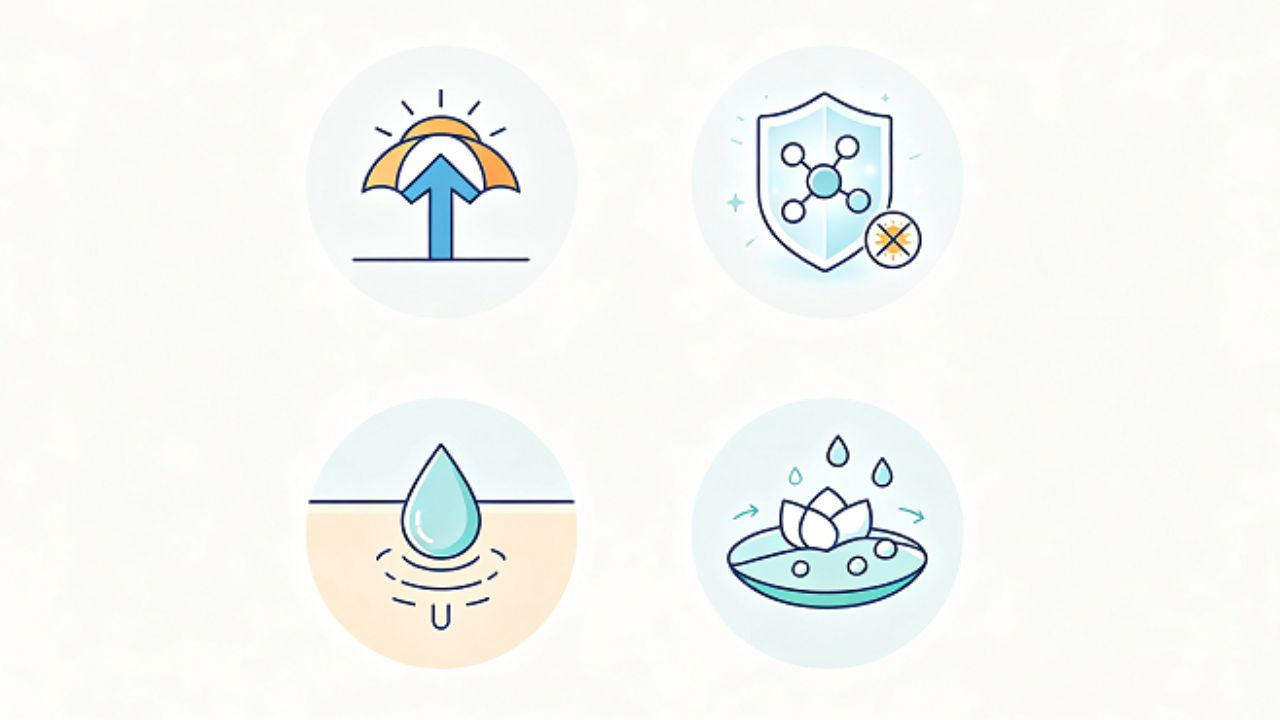
A sunscreen booster enhances your formula through four key mechanisms:
SPF enhancement – Achieve a higher SPF with less UV filter
Stability improvement – Prevent crystallization and photodegradation of UV filters
Skin feel optimization – Reduce greasiness and whitening effects
Water resistance reinforcement – Strengthen the sunscreen film’s durability on the skin
Types of Sunscreen Boosters
The market offers a wide variety of sunscreen boosters, and the right choice depends on your formulation goals and budget.
Oil-soluble synthetic polymers – e.g., Styrene/Acrylates Copolymer (SunSpheres). These work by scattering UV rays through hollow spherical particles.
Natural/sourced or modified polymers – e.g., Dextrin Palmitate, Algae Ketone. These combine film-forming properties with SPF-boosting functionality.
Esters/Emollients – They enhance SPF by dissolving, stabilizing, and solubilizing UV filters.
Plant extracts – Certain plant-derived active ingredients have also been found to exhibit SPF-boosting effects.
Two Typical Chemical Boosters
Comparison | Butyloctyl Salicylate | Ethylhexyl Methoxycrylene |
| Core Position | SPF booster + skin feel improver | Photostabilizer (Avobenzone guardian) |
| Best Application | Physical sunscreens (improves whitening, dissolves crystals) | Chemical sunscreens (long-lasting stabilization of Avobenzone) |
| Recommended Usage Rate | 1% – 5% | 3% – 5% (proportional to Avobenzone content) |
| Additional Benefits | Can be used as a compound photostabilizer in blends | Stabilizes retinol and other active ingredients |
Butyloctyl Salicylate
Core function: This is an excellent oil-soluble emollient that effectively dissolves and stabilizes crystalline UV filters, improving formula uniformity. At the same time, it significantly reduces the “whitening effect” commonly associated with physical sunscreens.
Efficacy data: Studies have shown that it can significantly boost the SPF value of pure physical sunscreen formulations.
Recommended dosage: Typical usage levels range from 1% to 5%.
Synergistic value: When combined with Acrylates Copolymer and other ingredients, it can function as a composite photostabilizer.
Ethylhexyl Methoxycrylene
Core function: As a highly efficient photostabilizer, its most prominent role is to stabilize Avobenzone and prevent its photodegradation.
Technical highlight: It is reported to dissolve approximately 32% of Avobenzone and outperforms Octocrylene in stabilizing Avobenzone.
Recommended dosage: The recommended usage level typically matches the amount of Avobenzone in the formula, generally ranging from 3% to 5%.
Additional advantage: It can also photostabilize active ingredients such as Retinol, adding extra value to your product.
Market trends for Sunscreen Boosters
In recent years, consumer demand for high-SPF mineral sunscreens with a non-whitening effect has surged dramatically—and with it, the use of SPF boosters has risen significantly. According to industry reports, Google searches for “mineral sunscreen” grew by nearly 30% year-over-year in 2024, with growth accelerating further to 35.8% in 2025.
FAQ
Q:Is Butyloctyl Salicylate safe?
A:Yes. According to the Cosmetic Ingredient Review (CIR) Expert Panel, Butyloctyl Salicylate is considered safe for use in cosmetics. Its larger molecular weight results in lower skin absorption compared to structurally similar Octocrylene, making it a safer alternative.
Q:Does sunscreen booster (e.g., Butyloctyl Salicylate) affect pregnancy?
A:Currently, there is no evidence suggesting that Butyloctyl Salicylate poses a risk to pregnancy at the recommended usage levels (1%-5%). According to the EWG assessment, its developmental and reproductive toxicity risk is rated as “Low.” However, pregnant women are advised to pay more attention to UV filters themselves, and should consider prioritizing physical sunscreens (mineral sunscreens).
Q:Is a booster the same as a UV filter?
A:No. A sunscreen booster (SPF Booster) and a UV filter are two different types of ingredients. Strictly speaking, all sunscreen boosters are not UV filters—although some boosters can achieve UV-filter-like effects at higher usage levels.
Q:What does Ethylhexyl Methoxycrylene mean for Avobenzone?
A:Ethylhexyl Methoxycrylene (SolaStay S1) is a versatile photostabilizer. If you want your Avobenzone to deliver long-lasting protection and a high PA rating, you must pair it with a stabilizer—and Ethylhexyl Methoxycrylene is one of the best options available.
Q:What’s the difference between Butyloctyl Salicylate and Octocrylene?
A:These are two completely different ingredients with distinct roles. Butyloctyl Salicylate is a sunscreen booster (classified as a non-active ingredient), while Octocrylene is a chemical UV filter (classified as an active ingredient). The core difference: one is an “assistant” that helps boost SPF, while the other is a “frontline player” that directly absorbs UV radiation.
Q:How do you select the right sunscreen booster based on your formulation system?
A:You can make your choice based on the type of formulation and your core objectives; there is no “one-size-fits-all” solution—only the option that best suits your specific formula.
| Your Formulation Pain Points | Recommended Booster Type |
| Whitening & insufficient SPF in physical sunscreens | Butyloctyl Salicylate (disperses minerals + boosts SPF) |
| Poor photostability of Avobenzone | Ethylhexyl Methoxycrylene (photostabilization) |
| Uneven sunscreen film with weak spots | Film-forming polymers (improves film thickness & uniformity) |
| High SPF desired with lightweight skin feel | Combination of multiple boosters (reduces total UV filter usage) |
Final Thought
Incorporating a booster into your sunscreen formulation reduces the total UV filter load, which helps mitigate the potential risks that high concentrations of chemical UV filters may pose to both skin and marine ecosystems—making your product more aligned with modern sustainability trends.
The maturity of booster technology has made it possible to achieve both high SPF and great skin feel—no more trade-offs.
If you’re looking for more information on UV filters and sunscreen boosters, feel free to reach out to Highassay for expert guidance and product details.