This article provides a comprehensive overview of the periodic table, covering its definition, century-long evolution, atomic numbers, element classification, the forms in which the 118 elements exist, synthetic elements, and electronegativity trends. It also includes a table of elemental properties, making it a valuable resource for chemistry studies and chemical industry reference.
What is the Periodic Table of Elements?
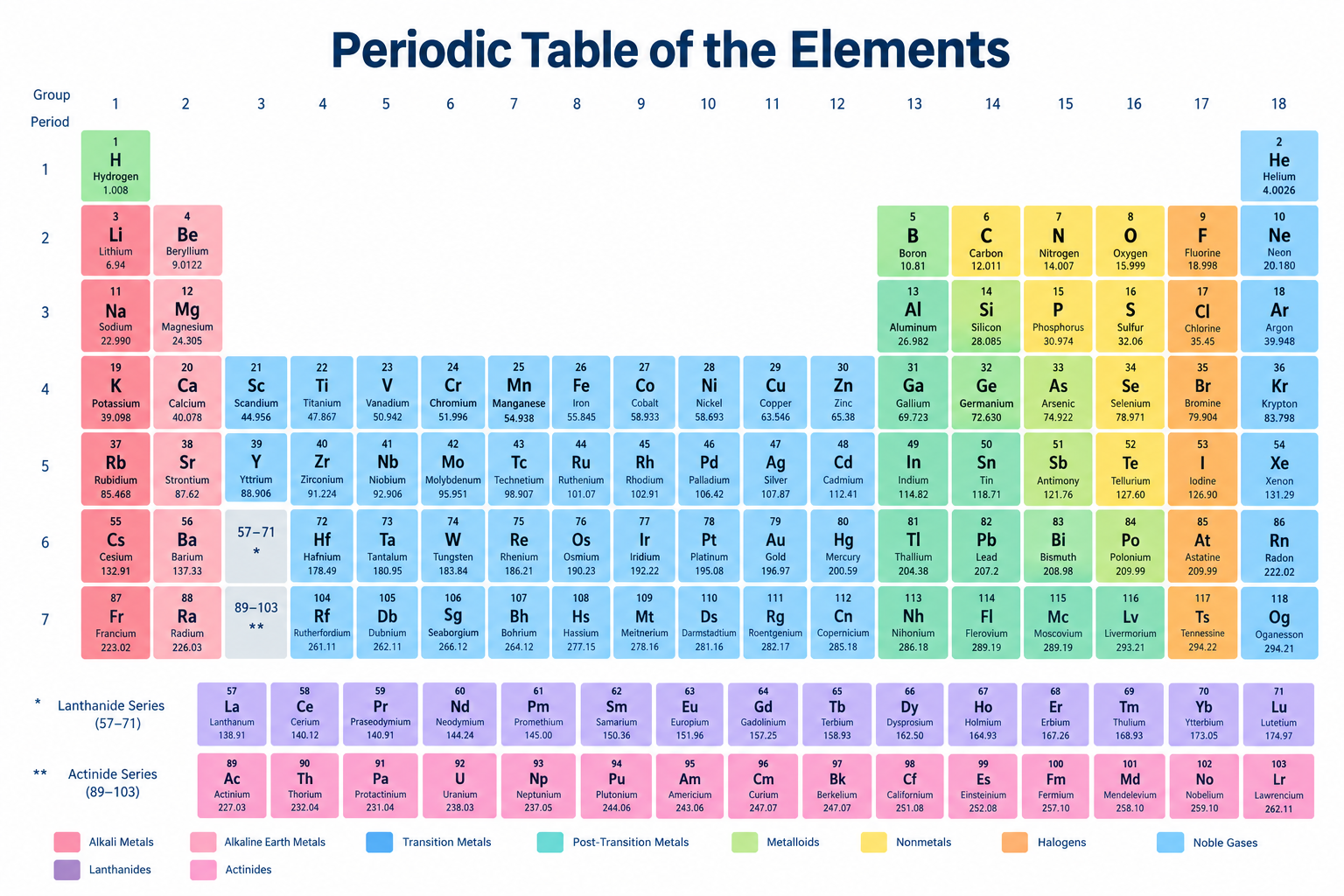
Periodic Table(also called Periodic Table of Elements) is based on the periodic law.
The Periodic Table is arranged by increasing atomic number; horizontal rows are called periods and vertical columns are called groups, with elements in the same group sharing similar properties.
The first version of the Periodic Table was published by the Russian chemist Dmitri Mendeleev in 1869.
The Periodic Table reveals the intrinsic link between atomic structure and the properties of matter; by organizing disparate chemical elements into a comprehensive system and successfully predicting elements yet to be discovered, it has made immense contributions to chemical research, the development of new materials, and our understanding of the microscopic nature of matter.
The Centennial Evolution of the Periodic Table
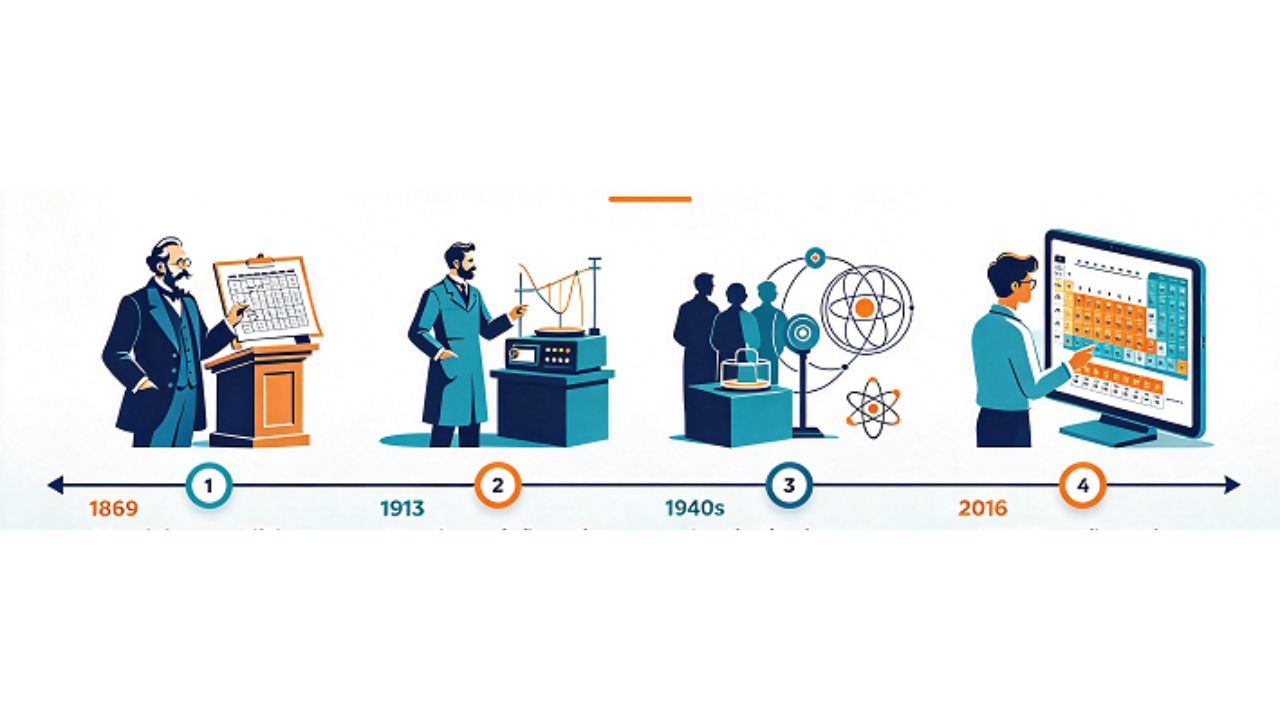
- The Priodic Table has evolved over the course of a century:
- Early chemists sought to uncover the underlying patterns governing the elements;
- In 1869, Mendeleev pioneered the periodic table and successfully predicted the existence of unknown elements;
- In 1913, Moseley discovered atomic number, thereby refining the fundamental ordering logic of the table;
- Subsequent research into atomic structure and experiments in nuclear physics led to the discovery of artificially synthesized superheavy elements;
- Ultimately, the system evolved into the modern periodic table comprising 118 elements.
The Fundamental Criterion for the Arrangement of the Periodic Table: Atomic Number
Definition
Atomic number (symbol Z) refers to the position number of an element in the periodic table.
Fundamental Nature
Atomic number = number of protons = nuclear charge; for a neutral atom, it also equals the number of extranuclear electrons.
Why aren’t they arranged by Atomic Weight?
Mendeleev originally arranged them by atomic weight, but since atomic weight is influenced by the number of neutrons, there were exceptions.
In 1913, Moseley confirmed that it is the number of protons (atomic number)—not atomic weight—that determines an element’s chemical properties.
Atomic Number vs. Atomic Mass
- Atomic number: The number of protons; it determines the element.
- Relative atomic mass: The total mass of protons and neutrons; since the same element can have multiple isotopes, the atomic mass can vary.
From that point on, the periodic table was arranged by atomic number. This also serves as the fundamental logic behind the modern periodic table.
Classification Methods of the Periodic Table
The classification system of the Periodic Table is a human construct designed to group elements with similar properties, thereby facilitating the identification of patterns and the prediction of unknown elements—which constitutes the table’s core value.
Common Classification Criteria:
- By metallic character: Metals / Nonmetals / Metalloids
- By electron configuration: s-block / p-block / d-block / f-block
- By standard state of matter: Solids / Liquids / Gases
- By property similarity: Element families (as shown below)
Element Family | Coverage |
| Alkali Metal | Group 1 (exclude H: Li, Na, K, Rb, Cs, Fr) |
| Alkaline Earth Metal | Group 2 (Be, Mg, Ca, Sr, Ba, Ra) |
| Transition Metal | Group 3 ~ Group 12 (excluding lanthanides and actinides) |
| Lanthanide | La–Lu (Atomic number 57–71, inner transition metals) |
| Actinide | Ac–Lr (Atomic number 89–103, inner transition metals) |
| Metalloid | B, Si, Ge, As, Sb, Te, Po |
| Post-Transition Metal | Metals in Group13~16: Al, Ga, In, Sn, Tl, Pb, Bi |
| Nonmetal | H, C, N, O, P, S, Se |
| Halogen | Group17: F, Cl, Br, I, At, Ts |
| Noble Gas | Group18: He, Ne, Ar, Kr, Xe, Rn, Og |
Forms of Existence of the 118 Elements in the Periodic Table (Two Dimensions)
Dimension 1: Standard state (25°C, 1 atm, physical state of the element)
- Solids: The vast majority of elements (approximately 95). Includes all metals and metalloids, as well as non-metals such as C, S, P, and I.
- Liquids: Only two—Br and Hg.
- Gases: Eleven—H, He, N, O, F, Ne, Cl, Ar, Kr, Xe, and Rn.
- Superheavy elements (104–118): Their states of matter are theoretically predicted; they cannot be produced in large quantities or experimentally verified.
Note: Og (element 118) is theoretically predicted to be a solid, not a gas.
Dimension 2: Sources of occurrence in the Earth’s crust
- Primordial stable elements: Present since the Earth’s formation; possess at least one stable isotope (atomic numbers 1–82, excluding Tc and Pm).
- Naturally occurring radioactive elements: Found in nature but possess unstable nuclei that undergo decay.
Tc (43), Pm (61), Po (84), At (85), Rn (86), Fr (87), Ra (88), Ac (89), Th (90), Pa (91), U (92), Np (93), Pu (94)
- Artificially synthesized elements: Atomic numbers 95–118; no primordial abundance on Earth; produced via nuclear reactions.
Note: Trace amounts of Tc, Pm, Np, and Pu exist in nature, but they are typically categorized under either artificially synthesized or naturally radioactive elements in discussions.
What are Artificial Elements?
Synthetic elements are elements that do not exist in nature—or exist only in trace amounts—and are primarily produced through artificial nuclear reactions.
Most synthetic elements have extremely short half-lives and exist only briefly; however, a few have very long half-lives, such as Pu-244, which is approximately 80 million years.
Synthetic Elements are Primarily Produced via Two Methods
- Neutron capture in nuclear reactors
- Heavy-ion bombardment in particle accelerators
Classification of Synthetic Elements
- Elements existing in trace amounts in nature: Tc (43), Pm (61), Np (93), Pu (94)
- Elements that are entirely synthetically produced: Atomic numbers 95–118
Note: Strictly speaking, all elements with atomic numbers 95 and above are synthetic; while elements 43, 61, 93, and 94 occur in nature in trace amounts, they are also typically categorized as synthetic elements.
Significance of Synthetic Elements
- Expanding the periodic table
- Advancing fundamental research in nuclear physics and nuclear chemistry
- Facilitating scientific exploration
- Practical applications in industry and medicine:
Tc-99m: Medical imaging (bone scans, cardiac scans)
Pu-238: Nuclear power sources for spacecraft (e.g., Voyager, Curiosity)
Am-241: Smoke detectors
Electronegativity of Elements
Definition of Electronegativity
The Electronegativity of an element refers to the ability of an atom within a molecule to attract shared electron pairs.
Electronegativity Symbol χ
Electronegativity Values
Electronegativity is a relative, dimensionless value, typically expressed using a specific scale.
A common scale is the Pauling scale, proposed by Linus Pauling.
Electronegativity values for common elements:
Element | Electronegativity (Pauling Scale) |
| F | 3.98 (highest value) |
| O | 3.44 |
| Cl | 3.16 |
| N | 3.04 |
| C | 2.55 |
| H | 2.20 |
| Na | 0.93 |
| Cs | 0.79 (one of the lowest values) |
The higher the electronegativity value, the stronger the atom’s ability to attract electrons within a chemical bond.
Fluorine (F) has the highest value on the periodic table, while Cesium (Cs) has the lowest.
General Trends of Electronegativity on the Periodic Table
- Across a period (left to right): Electronegativity increases (nuclear charge increases, atomic radius decreases, and electron-attracting ability strengthens).
- Down a group (top to bottom): Electronegativity decreases (atomic radius increases, outer electrons are further from the nucleus, and electron-attracting ability weakens).
- Overall trend: High electronegativity in the top-right corner (F, O, Cl, N); low electronegativity in the bottom-left corner (Cs, Fr).
Applications of Electronegativity
Determining Chemical Bond Type
- Electronegativity difference < 0.4: Nonpolar covalent bond
- Electronegativity difference 0.4 – 7: Polar covalent bond
- Electronegativity difference > 1.7: Generally considered an ionic bond
Note: 1.7 is merely an empirical threshold; exceptions exist, so it cannot serve as an absolute criterion.
Determining Molecular Polarity
- The greater the electronegativity difference, the stronger the bond polarity.
Determining Metallic/Non-metallic Character
- High electronegativity indicates strong non-metallic character; low electronegativity indicates strong metallic character.
Explaining the Direction of Chemical Reactions
- Electrons tend to flow from atoms with lower electronegativity to those with higher electronegativity.
Note: Electronegativity values for superheavy elements and certain radioactive elements are mostly theoretical predictions and cannot be experimentally measured.
Periodic Trends
Periodic trends refer to the regular changes in elemental properties that occur as atomic number increases across the periodic table.
| Property | Across a period (left → right) | Down a group (top → bottom) |
| Atomic Radius | Decreases | Increases |
| Ionization Energy | Increases | Decreases |
| Electronegativity | Increases | Decreases |
| Metallic Character | Decreases | Increases |
Periodic Table of Elements: Complete Data Table for All 118 Elements
Atomic Number, Group, Electronegativity, Standard State
| Comprehensive Table of Information on the 118 Elements | ||||||
| Atomic number | Element symbol | Element Name | Group | Electronegativity(χ) | Element Category | Standard State((25°C, 1 atm) |
| 1 | H | Hydrogen | ⅠA | 2.2 | Non-metal | Gas |
| 2 | He | Helium | 0 Group | Noble gases | Gas | |
| 3 | Li | Lithium | ⅠA | 0.98 | Alkali metals | Solid |
| 4 | Be | Beryllium | ⅡA | 1.57 | Alkaline earth metals | Solid |
| 5 | B | Boron | ⅢA | 2.04 | Metalloid | Solid |
| 6 | C | Carbon | ⅣA | 2.55 | Non-metal | Solid |
| 7 | N | Nitrogen | ⅤA | 3.04 | Non-metal | Gas |
| 8 | O | Oxygen | ⅥA | 3.44 | Non-metal | Gas |
| 9 | F | Fluorine | ⅦA | 3.98 | Halogen | Gas |
| 10 | Ne | Neon | 0 Group | Noble gases | Gas | |
| 11 | Na | Sodium | ⅠA | 1.61 | Alkali metals | Solid |
| 12 | Mg | Magnesium | ⅡA | 1.31 | Alkaline earth metals | Solid |
| 13 | Al | Aluminum | ⅢA | Post-transition metals | Solid | |
| 14 | Si | Silicon | ⅣA | 1.9 | Metalloid | Solid |
| 15 | P | Phosphorus | ⅤA | 2.19 | Non-metal | Solid |
| 16 | S | Sulfur | ⅥA | 2.58 | Non-metal | Solid |
| 17 | Cl | Chlorine | ⅦA | 3.16 | Halogen | Gas |
| 18 | Ar | Argon | 0 Group | Noble gases | Gas | |
| 19 | K | Potassium | ⅠA | 0.82 | Alkali metals | Solid |
| 20 | Ca | Calcium | ⅡA | 1 | Alkaline earth metals | Solid |
| 21 | Sc | Scandium | ⅢB | 1.36 | Transition metal | Solid |
| 22 | Ti | Titanium | ⅣB | 1.54 | Transition metal | Solid |
| 23 | V | Vanadium | ⅤB | 1.63 | Transition metal | Solid |
| 24 | Cr | Chromium | ⅥB | 1.66 | Transition metal | Solid |
| 25 | Mn | Manganese | ⅦB | 1.55 | Transition metal | Solid |
| 26 | Fe | Iron | Ⅷ | 1.83 | Transition metal | Solid |
| 27 | Co | Cobalt | Ⅷ | 1.88 | Transition metal | Solid |
| 28 | Ni | Nickel | Ⅷ | 1.91 | Transition metal | Solid |
| 29 | Cu | Copper | ⅠB | 1.9 | Transition metal | Solid |
| 30 | Zn | Zinc | ⅡB | 1.65 | Transition metal | Solid |
| 31 | Ga | Gallium | ⅢA | 1.81 | Post-transition metals | Solid |
| 32 | Ge | Germanium | ⅣA | 2.01 | Metalloid | Solid |
| 33 | As | Arsenic | ⅤA | 2.18 | Metalloid | Solid |
| 34 | Se | Selenium | ⅥA | 2.55 | Non-metal | Solid |
| 35 | Br | Bromine | ⅦA | 2.96 | Halogen | Liquid |
| 36 | Kr | Krypton | 0 Group | 3 | Noble gases | Gas |
| 37 | Rb | Rubidium | ⅠA | 0.82 | Alkali metals | Solid |
| 38 | Sr | Strontium | ⅡA | 0.95 | Alkaline earth metals | Solid |
| 39 | Y | Yttrium | ⅢB | 1.22 | Transition metal | Solid |
| 40 | Zr | Zirconium | ⅣB | 1.33 | Transition metal | Solid |
| 41 | Nb | Niobium | ⅤB | 1.6 | Transition metal | Solid |
| 42 | Mo | Molybdenum | ⅥB | 2.16 | Transition metal | Solid |
| 43 | Tc | Technetium | ⅦB | 1.9 | Transition metal | Solid |
| 44 | Ru | Ruthenium | Ⅷ | 2.2 | Transition metal | Solid |
| 45 | Rh | Rhodium | Ⅷ | 2.28 | Transition metal | Solid |
| 46 | Pd | Palladium | Ⅷ | 2.2 | Transition metal | Solid |
| 47 | Ag | Silver | ⅠB | 1.93 | Transition metal | Solid |
| 48 | Cd | Cadmium | ⅡB | 1.69 | Transition metal | Solid |
| 49 | In | Indium | ⅢA | 1.78 | Post-transition metals | Solid |
| 50 | Sn | Tin | ⅣA | 1.96 | Post-transition metals | Solid |
| 51 | Sb | Antimony | ⅤA | 2.05 | Metalloid | Solid |
| 52 | Te | Tellurium | ⅥA | 2.1 | Metalloid | Solid |
| 53 | I | Iodine | ⅦA | 2.66 | Halogen | Solid |
| 54 | Xe | Xenon | 0 Group | 2.6 | Noble gases | Gas |
| 55 | Cs | Cesium | ⅠA | 0.79 | Alkali metals | Solid |
| 56 | Ba | Barium | ⅡA | 0.89 | Alkaline earth metals | Solid |
| 57 | La | Lanthanum | ⅢB | 1.1 | Lanthanides | Solid |
| 58 | Ce | Cerium | ⅢB | 1.12 | Lanthanides | Solid |
| 59 | Pr | Praseodymium | ⅢB | 1.13 | Lanthanides | Solid |
| 60 | Nd | Neodymium | ⅢB | 1.14 | Lanthanides | Solid |
| 61 | Pm | Promethium | ⅢB | Lanthanides | Solid | |
| 62 | Sm | Samarium | ⅢB | 1.17 | Lanthanides | Solid |
| 63 | Eu | Europium | ⅢB | Lanthanides | Solid | |
| 64 | Gd | Gadolinium | ⅢB | 1.2 | Lanthanides | Solid |
| 65 | Tb | Terbium | ⅢB | Lanthanides | Solid | |
| 66 | Dy | Dysprosium | ⅢB | 1.22 | Lanthanides | Solid |
| 67 | Ho | Holmium | ⅢB | 1.23 | Lanthanides | Solid |
| 68 | Er | Erbium | ⅢB | 1.24 | Lanthanides | Solid |
| 69 | Tm | Thulium | ⅢB | 1.25 | Lanthanides | Solid |
| 70 | Yb | Ytterbium | ⅢB | Lanthanides | Solid | |
| 71 | Lu | Lutetium | ⅢB | 1.27 | Lanthanides | Solid |
| 72 | Hf | Hafnium | ⅣB | 1.3 | Transition metal | Solid |
| 73 | Ta | Tantalum | ⅤB | 1.5 | Transition metal | Solid |
| 74 | W | Tungsten | ⅥB | 2.36 | Transition metal | Solid |
| 75 | Re | Rhenium | ⅦB | 1.9 | Transition metal | Solid |
| 76 | Os | Osmium | Ⅷ | 2.2 | Transition metal | Solid |
| 77 | Ir | Iridium | Ⅷ | 2.2 | Transition metal | Solid |
| 78 | Pt | Platinum | Ⅷ | 2.28 | Transition metal | Solid |
| 79 | Au | Gold | ⅠB | 2.54 | Transition metal | Solid |
| 80 | Hg | Mercury | ⅡB | 2 | Transition metal | Liquid |
| 81 | Tl | Thallium | ⅢA | 1.62 | Post-transition metals | Solid |
| 82 | Pb | Lead | ⅣA | 2.33 | Post-transition metals | Solid |
| 83 | Bi | Bismuth | ⅤA | 2.02 | Post-transition metals | Solid |
| 84 | Po | Polonium | ⅥA | 2 | Metalloid | Solid |
| 85 | At | Astatine | ⅦA | 2.2 | Halogen | Solid |
| 86 | Rn | Radon | 0 Group | Noble gases | Gas | |
| 87 | Fr | Francium | ⅠA | 0.7 | Alkali metals | Solid |
| 88 | Ra | Radium | ⅡA | 0.9 | Alkaline earth metals | Solid |
| 89 | Ac | Actinium | ⅢB | 1.1 | Lanthanides | Solid |
| 90 | Th | Thorium | ⅢB | 1.3 | Lanthanides | Solid |
| 91 | Pa | Protactinium | ⅢB | 1.5 | Lanthanides | Solid |
| 92 | U | Uranium | ⅢB | 1.38 | Lanthanides | Solid |
| 93 | Np | Neptunium | ⅢB | 1.36 | Lanthanides | Solid |
| 94 | Pu | Plutonium | ⅢB | 1.28 | Lanthanides | Solid |
| 95 | Am | Americium | ⅢB | 1.3 | Lanthanides | Solid |
| 96 | Cm | Curium | ⅢB | 1.3 | Lanthanides | Solid |
| 97 | Bk | Berkelium | ⅢB | 1.3 | Lanthanides | Solid |
| 98 | Cf | Californium | ⅢB | 1.3 | Lanthanides | Solid |
| 99 | Es | Einsteinium | ⅢB | 1.3 | Lanthanides | Solid |
| 100 | Fm | Fermium | ⅢB | Lanthanides | Solid | |
| 101 | Md | Mendelevium | ⅢB | 1.3 | Lanthanides | Solid |
| 102 | No | Nobelium | ⅢB | 1.3 | Lanthanides | Solid |
| 103 | Lr | Lawrencium | ⅢB | Lanthanides | Solid | |
| 104 | Rf | Rutherfordium | ⅣB | Transition metal | Solid | |
| 105 | Db | Dubnium | ⅤB | Transition metal | Solid | |
| 106 | Sg | Seaborgium | ⅥB | Transition metal | Solid | |
| 107 | Bh | Bohrium | ⅦB | Transition metal | Solid | |
| 108 | Hs | Hassium | Ⅷ | Transition metal | Solid | |
| 109 | Mt | Meitnerium | Ⅷ | Transition metal | Solid | |
| 110 | Ds | Darmstadtium | Ⅷ | Transition metal | Solid | |
| 111 | Rg | Roentgenium | ⅠB | Transition metal | Solid | |
| 112 | Cn | Ununbium | ⅡB | Transition metal | Solid | |
| 113 | Nh | Ununtrium | ⅢA | Post-transition metals | Solid | |
| 114 | Fl | Ununquadium | ⅣA | Post-transition metals | Solid | |
| 115 | Mc | Ununpentium | ⅤA | Post-transition metals | Solid | |
| 116 | Lv | Ununhexium | ⅥA | Post-transition metals | Solid | |
| 117 | Ts | Ununseptium | ⅦA | Halogen | Solid | |
| 118 | Og | Oganesson | 0 Group | Noble gases | Solid | |
FAQ
Q:Besides the Pauling scale, what are some other common scales for electronegativity?
A:The Mulliken scale, the Allred-Rochow scale, and the Sanderson scale. While the numerical values differ across these scales, the trends remain consistent.
Q:What are Isotopes?
A:Isotopes are different atoms of the same element that have the same number of protons but different numbers of neutrons.
Q:What is the Group in the Periodic Table?
A:The Group refers to a vertical column in the periodic table—a column of elements arranged from top to bottom—which typically share similar chemical properties. The standard periodic table has 18 Groups.
Q:How many Periods and Groups are there in the Periodic Table?
A:There are a total of 7 periods (horizontal rows) and 18 groups (vertical columns).
The first period contains only 2 elements, while the 6th and 7th periods each contain 32 elements.
Q:Why do Atoms have the same Atomic Number but different Atomic Masses?
A:Because isotopes exist. Atoms of the same element have the same number of protons but different numbers of neutrons, resulting in different atomic masses.
Q:What is Ionization Energy? Why does it increase from left to right across a period?
A:Ionization energy is the minimum energy required to remove an electron. Moving from left to right across a period, the atomic radius decreases and electrons are held more tightly, so the ionization energy increases.
Q:What are transition metals? How do they differ from main-group metals?
A:Transition metals are d-block elements (Groups 3–12) in which electrons fill d-orbitals; main-group metals are those in the s- and p-blocks, such as Na and Al. Transition metals typically have high melting points and can exhibit multiple oxidation states.
Q:What role does the Periodic Table play in the chemical industry?
A:It is used to determine elemental properties, predict the direction of reactions, select raw materials, design synthetic routes, and devise purification processes; it serves as a fundamental tool in inorganic chemistry and materials science.
Final Thought
The periodic table is a fundamental tool in inorganic chemistry, materials science, and the R&D of chemical raw materials. For active pharmaceutical ingredients (APIs) and high-purity chemicals, the physicochemical properties, electronegativity, and metallic or non-metallic characteristics of elements serve as vital references for synthesis, purification, and formulation design. Please browse our product catalog if you require high-purity chemical raw materials or APIs.