In the realm of cosmetic formulation, Pantothenic Acid and Panthenol are often collectively referred to as “Vitamin B5 ingredients.” You might wonder: why do the vast majority of skincare products incorporate Panthenol rather than free Pantothenic Acid? This article clarifies the distinctions between these two substances—Pantothenic Acid and Panthenol—by examining factors such as formulation stability, skin penetration, and processing compatibility.
The Fundamental Relationship Between Pantothenic Acid and Panthenol
Panthenol, commonly known as Provitamin B5, is a colorless to slightly yellow, transparent, viscous liquid. As a stable precursor to Pantothenic acid, it possesses stable physicochemical properties, making it suitable for direct incorporation into cosmetic formulations.
Pantothenic acid is vitamin B5 in the true sense and the core source of B5’s functional benefits; however, in its pure free form—a pale yellow, viscous, oily substance—it is unstable when exposed to acids, alkalis, or heat, making it difficult to add directly to cosmetic formulations.
The connection between the two:
Panthenol itself lacks direct vitamin activity when added to skincare products as a stable precursor. However, upon contact with the skin, it rapidly penetrates and is metabolized into pantothenic acid, thereby delivering moisturizing, soothing, and barrier-repairing effects.
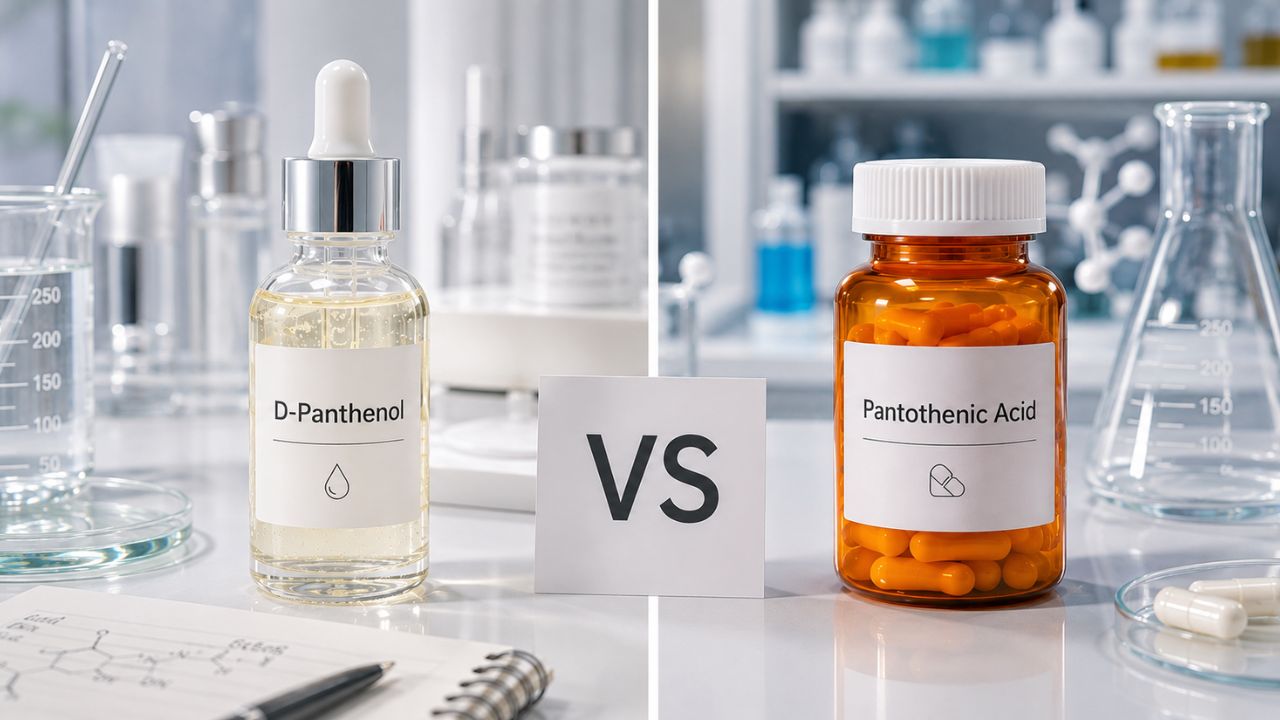
Comparison of Key Dimensions: Pantothenic Acid vs. Panthenol
| Comparison Dimension | Pantothenic Acid | D-Panthenol |
| Chemical Identity | Native Vitamin B5, biologically active form | Alcohol derivative of pantothenic acid, provitamin B5 |
| Formulation Stability | Poor. Prone to hydrolysis under water, pH fluctuation and high temperature; easy degradation during storage | Excellent. Resistant to deterioration under common cosmetic manufacturing conditions and longterm storage |
| Skin Feeling & Irritation | Relatively high irritation; not suitable for sensitiveskin formulations | Mild and lowirritation; compatible with sensitiveskin and babycare formulas |
| Skin Penetration | Weak molecular penetration, low skin utilization rate | Strong penetration into dermal layer with high conversion efficiency |
| Appearance | Paleyellow viscous oily substance | Colorless to slightly yellow clear viscous liquid with good purity |
| Cosmetic Formulation Compatibility | Not suitable for direct use in cosmetic formulations | Compatible with waterbased products, creams, lotions, serums and haircare products |
| Main Application Scenarios | Mostly used in oral nutritional supplements, rarely for external application | Key raw material for skincare, aesthetic repair, haircare and personalcare products |
Why can’t free Pantothenic Acid be used in skincare products?
As a brand formulator or a manager at a personal care manufacturing company, you need to understand the real reasons why Pantothenic Acid cannot be used directly in skincare products:
Instability in aqueous phases leads to product degradation
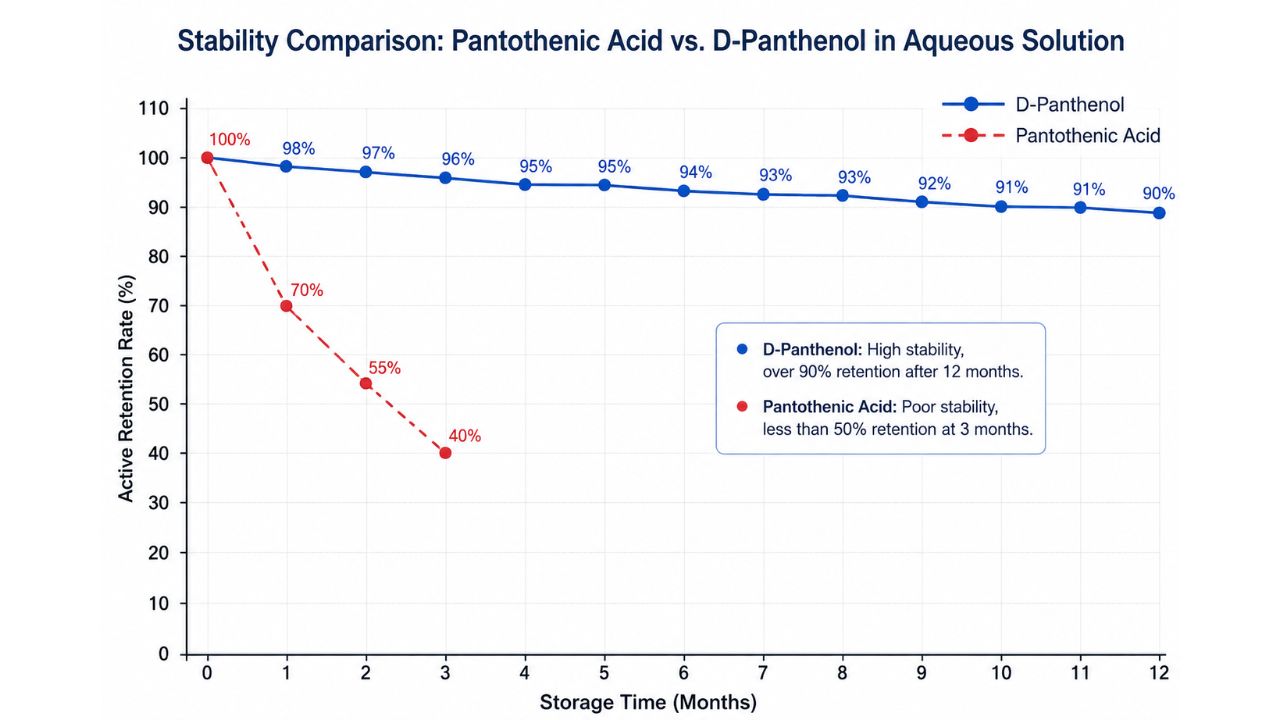
Pantothenic acid is highly prone to hydrolysis and degradation in water-based formulas. During production, filling, and long-term storage, the active ingredient continuously loses potency; the retention rate of its activity may drop below 50% just three months after filling.
Higher irritation potential limits the target audience
Direct contact with free Pantothenic Acid causes mild skin irritation. Consequently, it is unsuitable for premium applications such as products for sensitive skin or infants, resulting in a narrow range of use cases.
Panthenol’s conversion mechanism aligns better with skincare principles
Panthenol’s small molecular structure allows it to easily penetrate the lipid bilayer of the stratum corneum. Once this gentle ingredient penetrates the skin, it is metabolized into active Pantothenic Acid, ensuring long-lasting repair and hydration while avoiding the irritation risks associated with the direct use of Pantothenic Acid.
Production Considerations
As a skincare brand or a manufacturer of personal care products, it is essential to understand the pH and temperature tolerance ranges of Panthenol, as well as the differences between D-Panthenol and DL-Panthenol when selecting ingredients.
- The primary active component of Panthenol is derived from D-P It offers excellent formulation compatibility, fitting well within the standard pH range for cosmetics (4.0–8.0). While the production process does not require stringent temperature control, prolonged exposure to high heat should be avoided to prevent compromising product stability.
- There are two common types of Panthenol on the market; high-end personal care formulations exclusively use D-P D-Panthenol is the standard cosmetic-grade choice, valued for its high efficiency in skin conversion and superior repairing and moisturizing capabilities. In contrast, DL-Panthenol has only half the activity and lower efficacy, making it more suitable for low-end, budget-friendly formulations.
Selection Guide
Choose D-Panthenol for
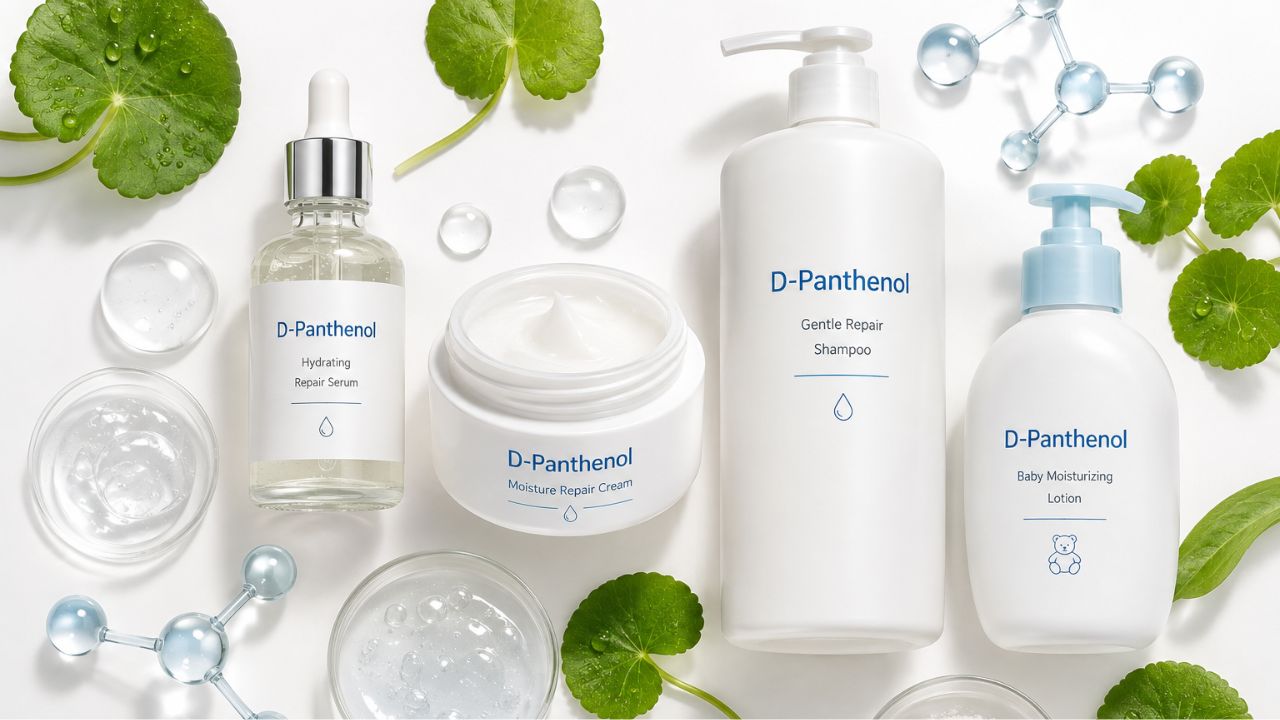
Hydrating serums, repairing creams, soothing masks, and post-procedure medical aesthetic repair products
Repair-focused hair care formulas (e.g., shampoos, conditioners, hair masks) to address frizz and dryness
Products for sensitive skin, baby and child care, and gentle personal care
Functional consumer care products requiring batch consistency, a long shelf life, and low irritation
Choose Pantothenic Acid for
Oral nutritional supplements and multivitamin formulations only; it is not recommended for use in any topical cosmetic formulas.
FAQ
Q: Can Panthenol be combined with acids, retinol, or niacinamide?
A: Yes. D-panthenol is highly compatible and is frequently combined with niacinamide, Centella asiatica, hyaluronic acid, AHAs, and retinol. It helps buffer the irritation caused by highly active ingredients while providing synergistic benefits for skin stability and barrier repair.
Q: Why do Panthenol-based formulas sometimes discolor or turn yellow? How can this be prevented?
A: Panthenol itself has very slight coloration; however, prolonged exposure to high heat, strongly acidic or alkaline environments, high impurity levels, or long-term storage in open containers can cause the formula to yellow. Issues with discoloration can be effectively prevented by adding the ingredient at lower temperatures during production, controlling the pH range, and using high-purity D-panthenol.
Q: Is Panthenol heat-stable in formulations? What is the recommended order of addition during production?
A: D-panthenol has good heat stability, though prolonged boiling at temperatures above 100°C is not recommended. For personal care product manufacturing, it is advisable to add it during the late emulsification or cooling stages to maximize the preservation of the raw material’s activity and the formula’s stability.
Q: Does the Panthenol in skincare products lose its effectiveness over the shelf life?
A: High-purity D-panthenol is extremely stable. When stored in sealed, light-protected conditions at room temperature, its efficacy shows minimal degradation throughout the shelf life. Unlike free pantothenic acid, it does not rapidly lose activity, making it ideal for the long-term storage requirements of skincare products.
Q: What precautions should be taken when using Panthenol in skincare products for infants, children, or sensitive skin?
A: Formulations for infants, children, and sensitive skin must use high-purity D-panthenol, strictly avoiding low-cost DL-panthenol or raw materials with excessive impurities. Additionally, using an appropriate concentration ensures the product remains gentle and non-irritating while delivering superior repair benefits.
Final Thought
Although Panthenol and Pantothenic Acid belong to the same metabolic pathway and share similar functional properties, they are not interchangeable in cosmetic formulations. Thanks to its stability, mildness, and transdermal permeability, D-Panthenol has become a mainstream B5-active ingredient in cosmetics, medical-aesthetic repair products, and personal care formulations.
If you are exploring high-purity, cosmetic-grade Panthenol ingredients from various sources or require detailed specifications, please leave a message on the site to obtain a Certificate of Analysis (COA) or other technical documentation.