Purines and Pyrimidines are two major groups of Nucleobases.They form the building blocks of DNA and RNA nucleosides.You can tell Purines and Pyrimidines apart by their ring structure.This article covers structure, base pairing and metabolism.It also talks about commercial Nucleoside raw materials.
What Are Purines and Pyrimidines?
What is Purine?
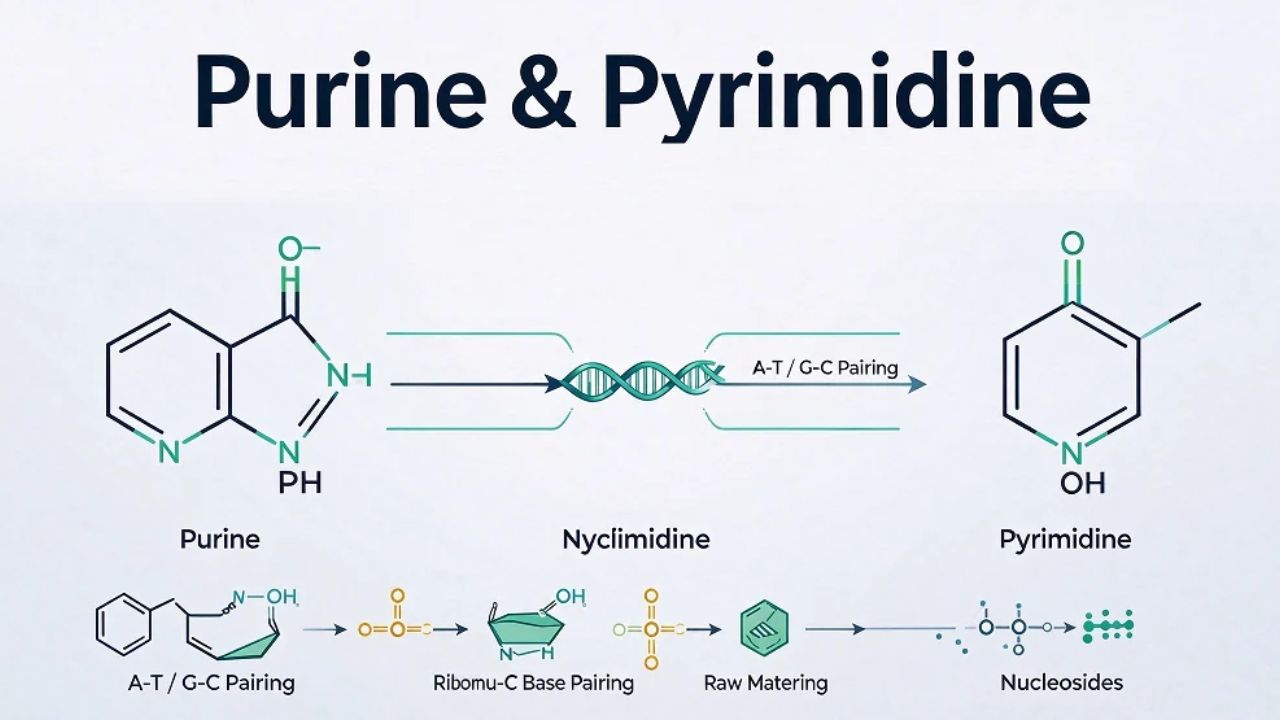
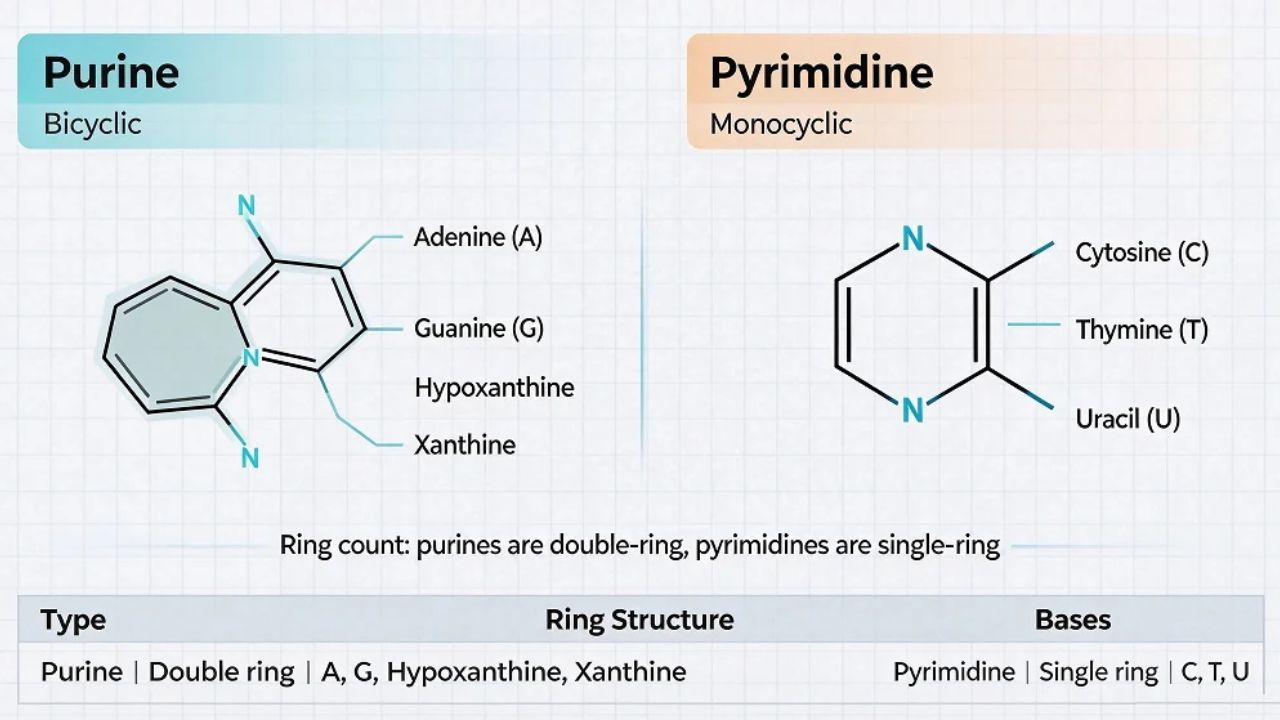
Purine is a nitrogen-containing heterocyclic aromatic organic compound.It has a bicyclic structure, formed by the fusion of a pyrimidine ring and an imidazole ring.
Common Purine nucleobases in nucleic acids:
- Adenine (A)
- Guanine (G)
There are other purine substances present in the human body, namely Hypoxanthine and Xanthine.These two purines are intermediate products in the catabolism of Adenine and Guanine.
Hypoxanthine is the base of Inosine.Inosine is a widely used Purine nucleoside.
What is Pyrimidine?
Pyrimidine is a six-membered heterocyclic compound.Two nitrogen atoms sit on the ring.It carries aromatic properties.Pyrimidine has a single-ring structure,and its molecular size is smaller.
Common pyrimidine nucleobases:
- Cytosine (C): found in DNA and RNA;
- Thymine (T): found only in DNA;
- Uracil (U): found only in RNA.
Type | Ring Structure | Nucleobases |
| Purine | Double ring | Adenine, Guanine, Hypoxanthine, Xanthine |
| Pyrimidine | Single ring | Cytosine, Thymine, Uracil |
 Base Pairing Rules
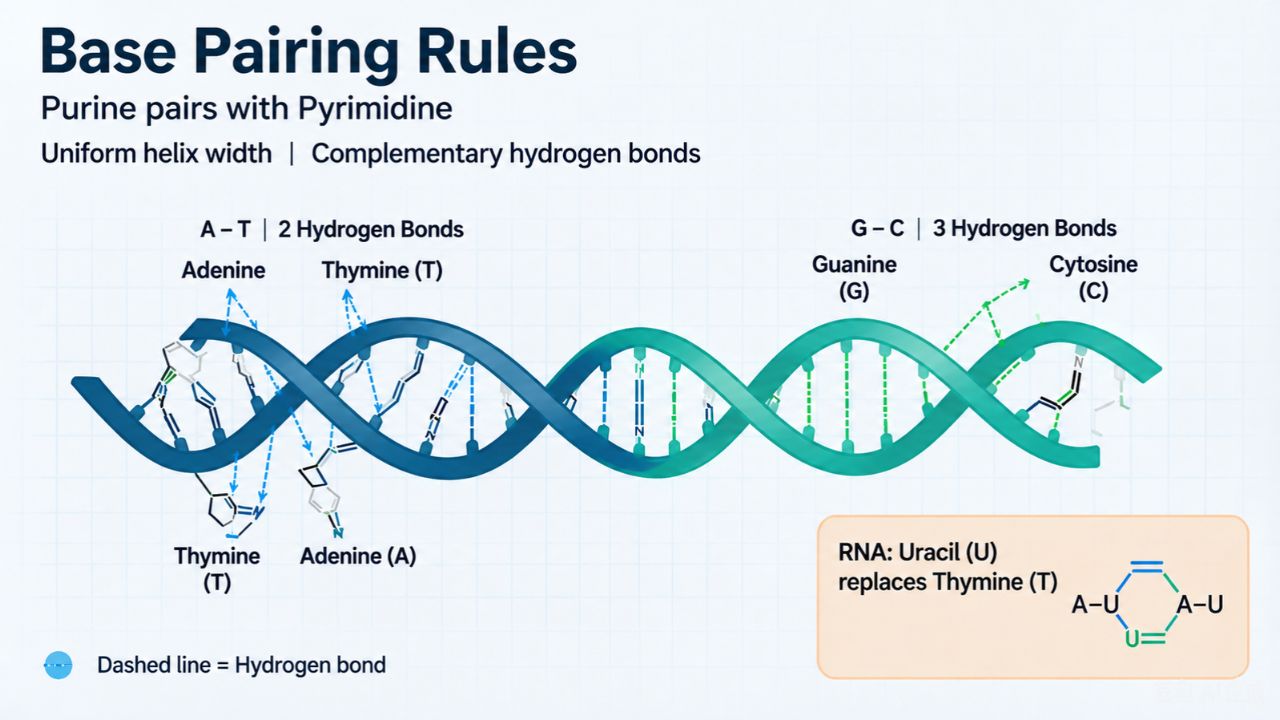
Base pairing follows fixed rules.Double-ring purine matches single-ring pyrimidine.This keeps uniform width of the DNA double helix.At the same time, specific pairing allows for the formation of complementary hydrogen bonds.
Standard pairing:
- Adenine(A) forms two hydrogen bonds with Thymine(T);
- Guanine (G) pairs with cytosine (C) via three hydrogen bonds.
- In RNA, Thymine is replaced by Uracil, so Adenine (A) pairs with Uracil (U).
The Relationship Between Purines, Pyrimidines, and Nucleosides
A nucleoside is composed of a base and a pentose sugar; bases are categorized into Purines and Pyrimidines.Nucleosides are grouped by sugar type and base type.
Ribonucleosides
The sugar component of a ribonucleoside is ribose.The bases involved include Purines and Pyrimidines.
- Purine ribonucleosides:- Adenosine、Guanosine、Inosine;
- Pyrimidine ribonucleosides:Cytidine、Uridine.
- Rare nucleosides also exist.Pseudouridine is a common rare nucleoside.Pseudouridine is widely found in tRNA.
Deoxyribonucleosides
Deoxyribonucleosides contain deoxyribose.They are building blocks of DNA.
- Purine deoxyribonucleosides:Deoxyadenosine、Deoxyguanosine;
- Pyrimidine deoxyribonucleosides:Deoxycytidine、Deoxythymidine.
Raw Material Procurement & Process Implementation Advice
For procurement professionals, the physicochemical differences between Purine and Pyrimidine bases are often overlooked; yet, these characteristics directly influence stability during nucleoside synthesis, final product yields, and the complexity of downstream purification.
Purine bases
- Exhibit relatively low water solubility and a tendency to crystallize out of solution.
- Require strict control over feeding rates, solvent systems, and reaction temperatures.
- Prevent the localized encapsulation of raw materials to ensure the reaction proceeds to completion.
Pyrimidine bases
- Possess better water solubility, allowing for greater flexibility in formulation.
- Are sensitive to pH levels and high temperatures, making them prone to degradation and the formation of new impurities.
Procurement recommendations
- Determine optimal feeding methods and safe concentration levels based on the specific manufacturing process.
- Plan crystallization and filtration strategies in advance.
- Ensure consistent quality specifications across batches.
FAQ
Q:Can you describe one way to differentiate Purines from Pyrimidines?
A:You can distinguish Purines from Pyrimidines by counting their rings. Purines have a fused double-ring structure; Pyrimidines have only one single ring. This visual structural feature is the most straightforward identification method.
Q:How many rings do Pyrimidines have?
A:Pyrimidines have one single aromatic heterocyclic ring. This single-ring structure is the most obvious structural feature that separates Pyrimidines from Purines.
Q:Purine vs Pyrimidine structure ,what are the key differences?
A:The core structural difference lies in the ring system. Purines adopt a fused double-ring structure (pyrimidine ring + imidazole ring), while Pyrimidines have only one six-membered single ring. This difference leads to differences in molecular size, hydrogen bonding sites and physicochemical properties such as solubility.
Q:What are the Pyrimidine Nucleotides?
A:Pyrimidine nucleotides are nucleotide monomers built from a Pyrimidine base, a pentose sugar and phosphate groups. The major naturally occurring Pyrimidine Nucleotides include Cytidine Monophosphate (CMP), Uridine Monophosphate (UMP), and Thymidine Monophosphate (TMP).
Final Thought
Whether for biological research or pharmaceutical industrial applications, understanding the fundamental differences between Purines and Pyrimidines will help you select the right raw material specifications and mitigate production risks.