Are you curious why fresh cassava is toxic, yet commercial cassava flour and starch are safe to use?For buyers in food manufacturing, bubble tea ingredients, or commercial baking: this guide covers where cassava’s toxicity comes from, why professionally processed cassava products are entirely safe, and how to judge the quality of the cassava raw material.
Cassava, Manioc, Yuca: Three Names for the Same Ingredient
Whether you search for Cassava, Manioc, or Yuca, you are looking at the same essential raw material. For B2B buyers in North America, Europe, and Latin America, the product is referred to as Cassava, Manioc, and Yuca respectively.
⚠️ Note the spelling: Yuca (cassava) ≠ Yucca (an ornamental plant).
Why Is Fresh Cassava Toxic? A Scientific Analysis of Cyanogenic Glycosides and Hydrocyanic Acid
Fresh cassava roots, stems, and leaves contain cyanogenic glycosides, which are natural plant toxins.Mainly composed of Linamarin (accounting for over 90% of total cyanogenic glycosides) and Lotaustralin, which serve as a natural plant defense mechanism.It is non-toxic in itself; however, when plant tissues are damaged,like chewing, grinding, or chopping,it generates hydrocyanic acid under the action of linamarase.
Hydrocyanic acid is a rapidly acting cytotoxinIts toxic mechanism is as follows: it inhibits cytochrome oxidase, blocks the mitochondrial respiratory chain, and prevents human tissue cells from utilizing oxygen in the blood — essentially acting as a chemical asphyxiant.
Specific Toxic Dose (For B2B Quality Control Reference):
| Exposure Type | Dose / Concentration | Effect / Consequence |
| Raw sweet cassava | Approximately 50g | Mild poisoning symptoms |
| Raw bitter cassava | Approximately 50g | Severe poisoning |
| Raw bitter cassava | Approximately 500g | Potentially fatal |
| HCN concentration in air | 300 mg/m³ | Immediately life-threatening |
| Safe limit for cassava products | <10 mg/kg (food grade) | Codex Alimentarius international standard |
The toxicity of fresh cassava is real, but entirely manageable.Proper industrial processing can remove more than 99% of cyanogenic glycosides.This is also why fresh cassava cannot be consumed directly, whereas commercially available cassava starch and cassava flour can be safely used in the food industry.
Sweet Cassava vs. Bitter Cassava
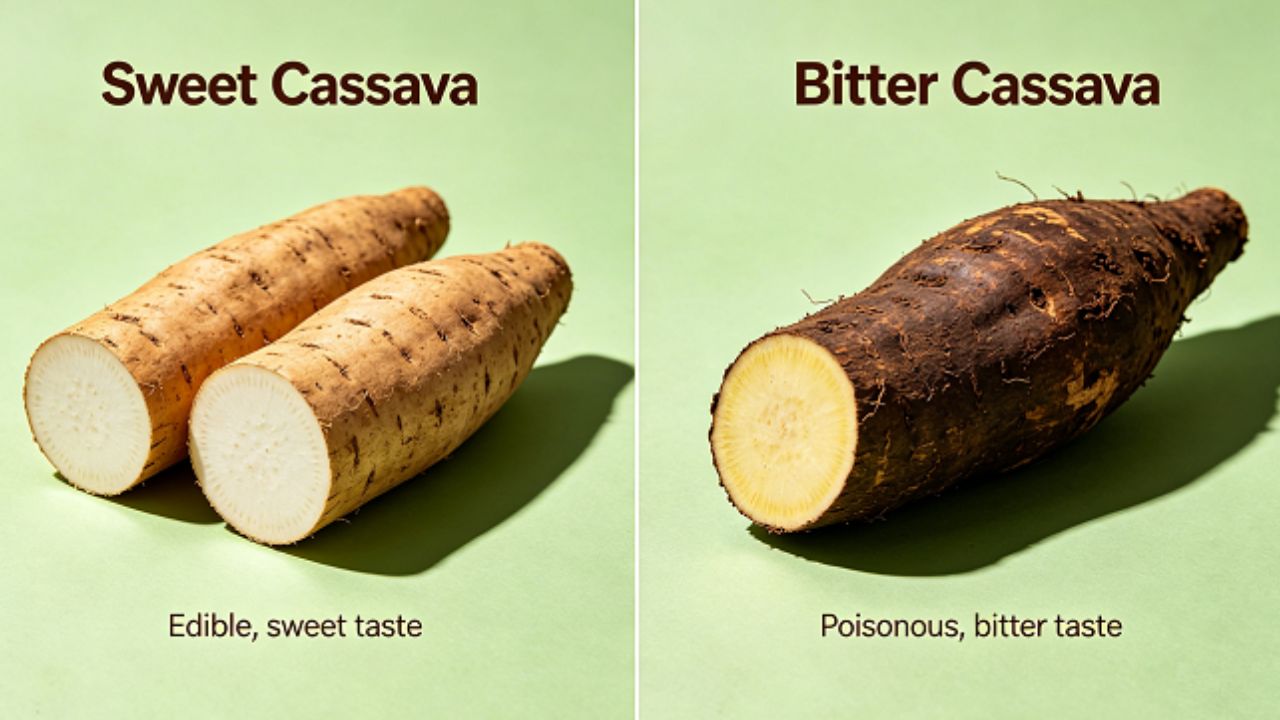
Sweet cassava and bitter cassava are two varieties of the cassava plant. Both contain cyanogenic glycosides and cannot be consumed raw; they differ only in their level of toxicity.
Sweet cassava:
Sweet cassava is an edible variety of cassava.The epidermis is predominantly reddish-brown or pale greenish-blue; the skin is thin and easily torn.The inner lining is pale pink, and the flesh is milky white.Its toxins are primarily concentrated in the skin, while the content in the edible parts is extremely low.
Sweet cassava is typically consumed fresh (steamed, boiled, prepared in sweet soups, or stir-fried), though it may also undergo limited processing.The preparation method is also relatively simple: simply peel, soak for 12 to 24 hours, and cook thoroughly.
Bitter Cassava:
Bitter Cassava is an industrial/processing-type cassava.The outer skin is grayish-brown to dark brown; it is thick, adheres tightly to the inner layer, and is difficult to peel off.Both the inner rind and the flesh are white.Toxins are uniformly distributed throughout its cortex and fleshy tissue, and their concentration is high.
Bitter cassava is used for the industrial extraction of starch (cassava flour), animal feed, and ethanol.Compared to sweet cassava, it has a higher starch content and serves as the primary raw material for industrial cassava flour.
If you are purchasing cassava raw materials for industrial processing (cassava flour, cassava starch, etc.), bitter cassava is the mainstream choice.Due to its higher starch content (reaching 30–35%), it yields a high flour extraction rate.When purchasing processed cassava flour, you need only focus on the test report; there is no need to be concerned about whether the raw material was sweet or bitter.
How to Properly Process Cassava: Traditional vs. Industrial Methods
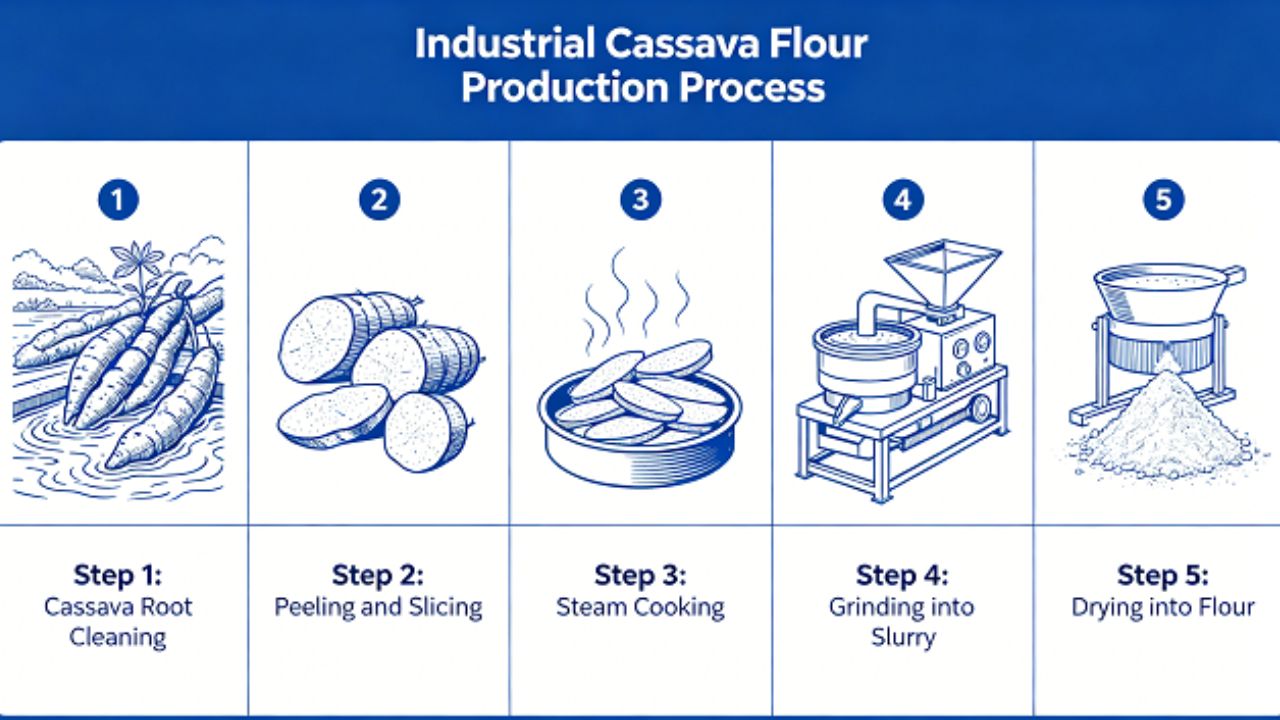
We know that fresh cassava is toxic due to the presence of cyanogenic glycosides, which are water-soluble and readily decompose at high temperatures.Since fresh cassava can be made safe for consumption through traditional home methods like soaking and heating, the safety of industrially processed cassava flour and tapioca starch is naturally even higher.
Industrially produced food-grade cassava flour undergoes standardized detoxification processes, including washing, crushing, multiple washings, high-temperature drying, and fine purification.It can remove more than 99% of the cyanogenic glycosides from cassava.Residual cyanide levels in the final product are controlled to below 5 mg/kg—well below the international safety limit of 10 mg/kg—making it entirely safe and suitable for use in industrial production applications such as food and animal feed.
Fresh Cassava vs. Tapioca Starch :A Safety Comparison
Comparison Dimension | Fresh Cassava | Industrial Cassava Starch |
| Cyanide glycoside level | High | Fully removed |
| Processing needed | Yes (mandatory) | No |
| Typical use cases | Home cooking | Food manufacturing, bubble tea, bakery |
| Safety status | Risky if underprocessed | Safe, meets national food safety standards |
Overall, the safety of edible cassava starch and cassava flour produced by legitimate factories is fully guaranteed. The “toxicity” you are concerned about has been systematically eliminated during the industrial processing stage.
Hydrocyanic Acid (HCN) Safety Limits for Cassava Products by Grade
For purchasers, safety is not a vague concept, but rather a set of quantifiable test metrics and verifiable documentation.
The safety standards for hydrocyanic acid are as follows:
- Food-grade cassava flour: < 10 mg/kg;
- Feed-grade cassava flour: < 50 mg/kg;
- Industrial-grade cassava flour: No strict limits on hydrocyanic acid content, but must comply with national standards;
- Cassava chips/pellets: < 10 mg/kg (Food-grade).
Reference Standards: Codex Alimentarius Commission (CAC), China National Standard GB/T 29343-2012
In addition to raw material specifications, supplier documentation is also essential:
- COA (Certificate of Analysis)
- Third-party test reports (e.g., SGS, Eurofins)
- Certificate of Origin
Before Purchasing Food-Grade Tapioca Starch, Check These 5 Key Indicators (Bookmark This!)
Item | Standard Range | Testing Method |
| Hydrocyanic Acid Content | <10 mg/kg (Food Grade) | National Standard GB 5009.36 |
| Whiteness | ≥92% | Whiteness Meter |
| Fineness | 80–120 Mesh | Sieving Method |
| Moisture | ≤13% | Oven Drying Method |
| Sulfur Dioxide | ≤30 mg/kg | National Standard GB 5009.34 |
FAQ
Q:Which method of virus elimination is most thorough for cassava?
A:Fermentation is the most thorough way to detoxify,and it is the core process for the traditional production of products such as cassava flour and cassava cakes.
After thorough fermentation, a large amount of the cyanogenic glycosides in cassava will be broken down.When combined with subsequent cleaning, heating, or drying processes, this enables the final product to meet safety standards for use.
Q:If cassava is improperly processed, what symptoms of poisoning may occur?
A:If cassava is consumed without being thoroughly detoxified, it may cause adverse symptoms such as dizziness, nausea, vomiting, and difficulty breathing; in severe cases, it can affect the nervous system.But these symptoms occur only when consuming raw or improperly processed fresh cassava; cassava flour that has undergone standard industrial processing poses no such risk.
Q:How can one determine whether a batch of cassava flour is safe?
A:The simplest method: check the Hydrogen Cyanide (HCN) levels in the COA and third-party test reports.For food-grade applications, the level should be <10 mg/kg. If this information cannot be provided, or if the value exceeds the standard, use is not recommended.
Q:What is the shelf life of tapioca flour?
A:When stored in a cool, dry, and airtight environment, the shelf life of tapioca starch is generally 18 to 24 months. Once opened, it is recommended to use the product as soon as possible and to protect it from moisture.
Q:Can you provide samples?
A:Yes, certainly. We support the shipment of small-batch samples, allowing customers to test and confirm them before placing a bulk order. Click “Contact Us” on the right to request free samples.
Final Thought
Properly processed cassava flour/starch is safe.
For you as a buyer, the real risk lies not in the cassava itself, but in the supplier’s quality control capabilities.Selecting a supplier that provides comprehensive test reports, maintains a stable supply chain, and has a clear procedure for handling customer complaints is far more important than agonizing over whether or not cassava is toxic.
→→Click to view cassava flour specifications and the latest quotes.
If you require free samples or wish to make a bulk purchase, please feel free to contact us directly.