Bupivacaine is a widely used long-acting local anesthetic active pharmaceutical ingredient (API). Given that both the Bupivacaine Base and the Hydrochloride form appear as white crystalline powders, why is Bupivacaine Hydrochloride the more suitable choice for your injectable formulations? This article provides a comprehensive comparison of Bupivacaine Base and Bupivacaine Hydrochloride, helping pharmaceutical companies make informed decisions during the selection process.
What is Bupivacaine Base?
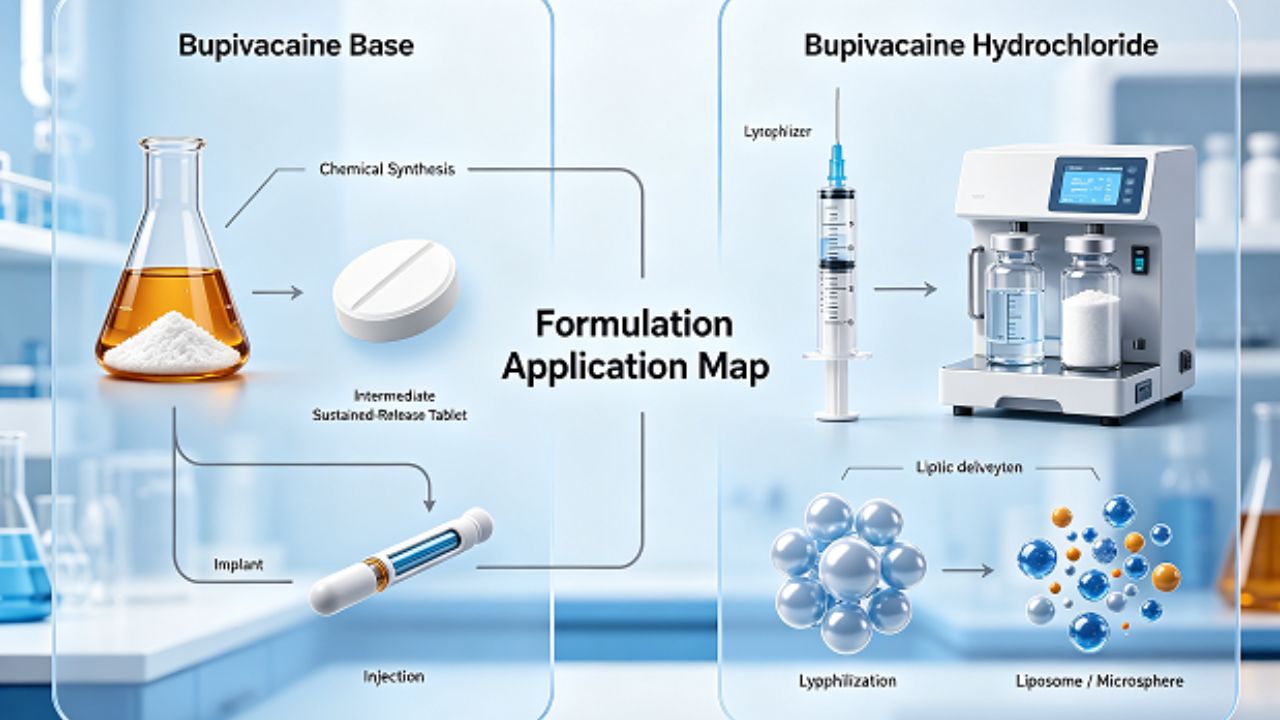
Bupivacaine Base (CAS: 2180-92-9) is the core active ingredient of the drug; however, due to its poor water solubility, it is rarely administered directly via injection in humans and is primarily used as an intermediate in the pharmaceutical industry. It has two main applications:
- Synthesis of Bupivacaine Hydrochloride: Bupivacaine Base is dissolved in a specific solvent and combined with hydrochloric acid; Bupivacaine Hydrochloride is then obtained through processes such as crystallization and filtration.
- Raw material for specialized formulations: Thanks to its high lipophilicity, it can serve as a direct raw material when developing specialized formulations, such as sustained-release or controlled-release products.
What is Bupivacaine Hydrochloride?
Bupivacaine Hydrochloride is the salt form of Bupivacaine, produced by the reaction of Bupivacaine Base with Hydrochloric Acid. This salt modification addresses the base’s poor water solubility and low stability, making it the only pharmaceutical-grade raw material that currently meets clinical standards for injection.
It is available in two specifications to suit different formulation requirements:
- Anhydrous Bupivacaine Hydrochloride (CAS: 14252-80-3): Suitable for specialized, customized formulations and moisture-sensitive compositions—such as the development of lyophilized products, liposomes, microspheres, and other controlled- or sustained-release dosage forms.
- Bupivacaine Hydrochloride Monohydrate (CAS: 73360-54-0): The mainstream global choice and the preferred form for commercial injectable products (e.g., 0.25%, 0.5%, and 0.75% Bupivacaine Injections). It features a mature manufacturing process and controllable costs, meeting the mass production needs of the vast majority of pharmaceutical companies.
Why is Bupivacaine Hydrochloride more suitable for injectable solutions?
Differences in water solubility
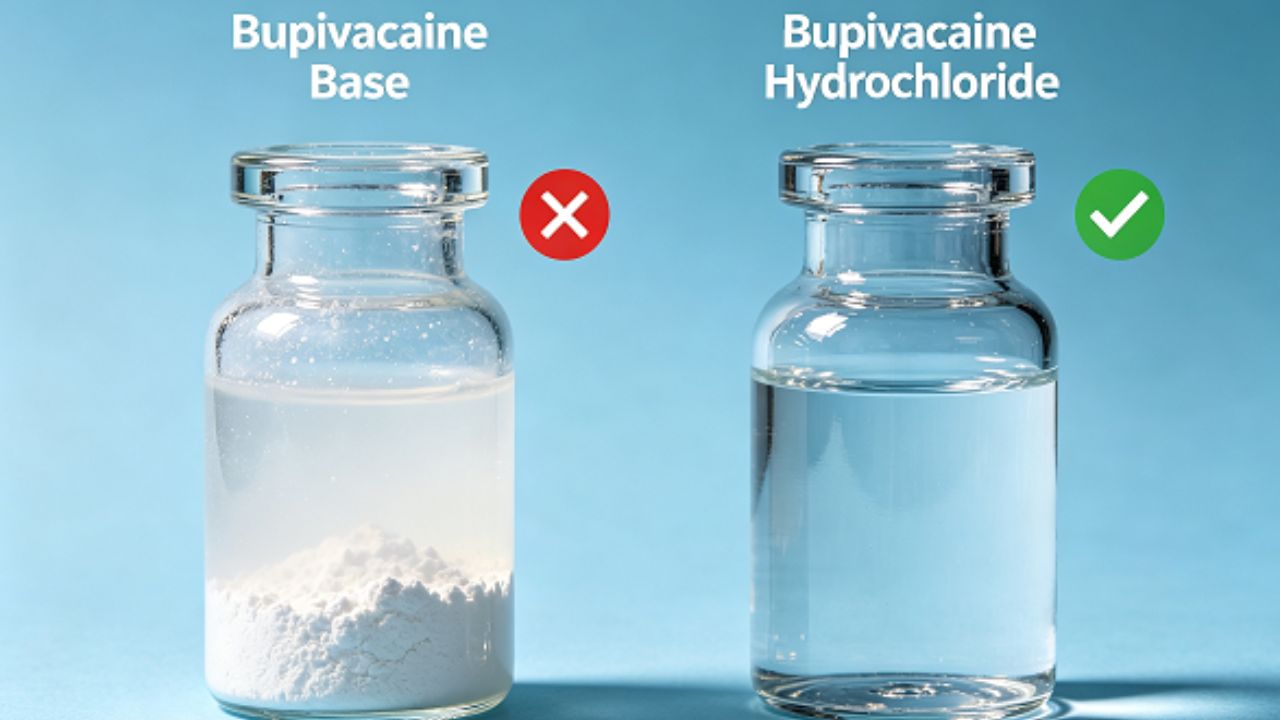
Bupivacaine injections are sterile aqueous preparations that require the drug to be completely and uniformly dissolved in an aqueous medium to form a stable solution. Bupivacaine Base is virtually insoluble in water, making it impossible to formulate an injection directly; attempting to do so would require large amounts of solubilizers, which not only complicates the manufacturing process but also increases pharmaceutical risks. In contrast, Bupivacaine Hydrochloride possesses excellent water solubility, resulting in a simpler and more stable formulation.
Stability of preparation
The water dispersion system of Bupivacaine Base is weakly alkaline. The environmental stability of Bupivacaine Hydrochloride is not as good as that of Bupivacaine Hydrochloride. It is prone to drug degradation when exposed to heat, light, and sterilization. It does not meet the injection quality standards and cannot be used in the production of injections.
The aqueous solution of Bupivacaine Hydrochloride is stable and weakly acidic, just in the most stable pH range of Bupivacaine Drugs (4.0–6.0). It is resistant to high temperature sterilization, not easy to hydrolyze, oxidize, and discolor, and can be stored for a long time at room temperature. The batch quality is stable and meets the standards for use of medical injections.
FAQ
Q:What is the difference between Bupivacaine and Bupivacaine Hydrochloride?
A:Bupivacaine (CAS No. 2180-92-9) is the free base form and has limited solubility in water. Bupivacaine Hydrochloride (CAS No. 14252-80-3/73360-54-0) is the salt form; it is highly water-soluble, widely used in clinical practice, and the standard API for developing injectable formulations. Our company supplies both products.
Q:Between Bupivacaine Base and Bupivacaine Hydrochloride, which is more suitable for manufacturing injections?
A:Bupivacaine Hydrochloride is more suitable. Its high water solubility meets the essential requirements for injectable formulations, making it the preferred API for the vast majority of bupivacaine injections.
Q:Can Bupivacaine Base and Bupivacaine Hydrochloride be converted into each other?
A:Yes. Industrially, high-purity Bupivacaine Hydrochloride is produced using Bupivacaine Base as the starting material through acidification (salt formation) and crystallization/purification. Conversely, converting the salt back to the base (desalting) holds no industrial value, and there is no need for formulation manufacturers to use the base form for reverse compounding.
Q:Are there differences in shelf life and storage conditions between the two APIs?
A:Yes, the differences are significant. Bupivacaine Hydrochloride crystals are stable and resistant to moisture absorption and oxidation; they can be stored long-term at room temperature in sealed containers. In contrast, Bupivacaine Base has a loose structure, is prone to moisture absorption and degradation, has poor storage stability, a shorter shelf life, and requires stricter control of warehouse temperature and humidity.
Final Thought
Bupivacaine Hydrochloride is a preferred, compliant raw material for injectable formulations, offering excellent water solubility, formulation stability, and suitability for mass production. Bupivacaine Base is better suited for pharmaceutical synthesis and specialized non-aqueous formulations.
Highassay offers three specifications of Bupivacaine. Please contact us if you require samples for testing or detailed technical data; we can provide precise raw material selection and technical support tailored to your specific formulation type.