Transcription requires complete double-stranded DNA, but each transcription uses only one strand as a template, called the template strand, and the other strand is called the coding strand. The transcription process consists of three phases: initiation, elongation, and termination.
The initiation phase includes the recognition of specific sites on the double-stranded DNA, local unwinding, and the formation of the initial RNA segment. The site of the first nucleotide incorporation is called the transcription start site (TSS). Previously, it was thought that the formation of the first phosphodiester bond would initiate the elongation phase, but it is now believed that the initiation process is more complex, and a small RNA segment has already been synthesized by the time elongation begins.
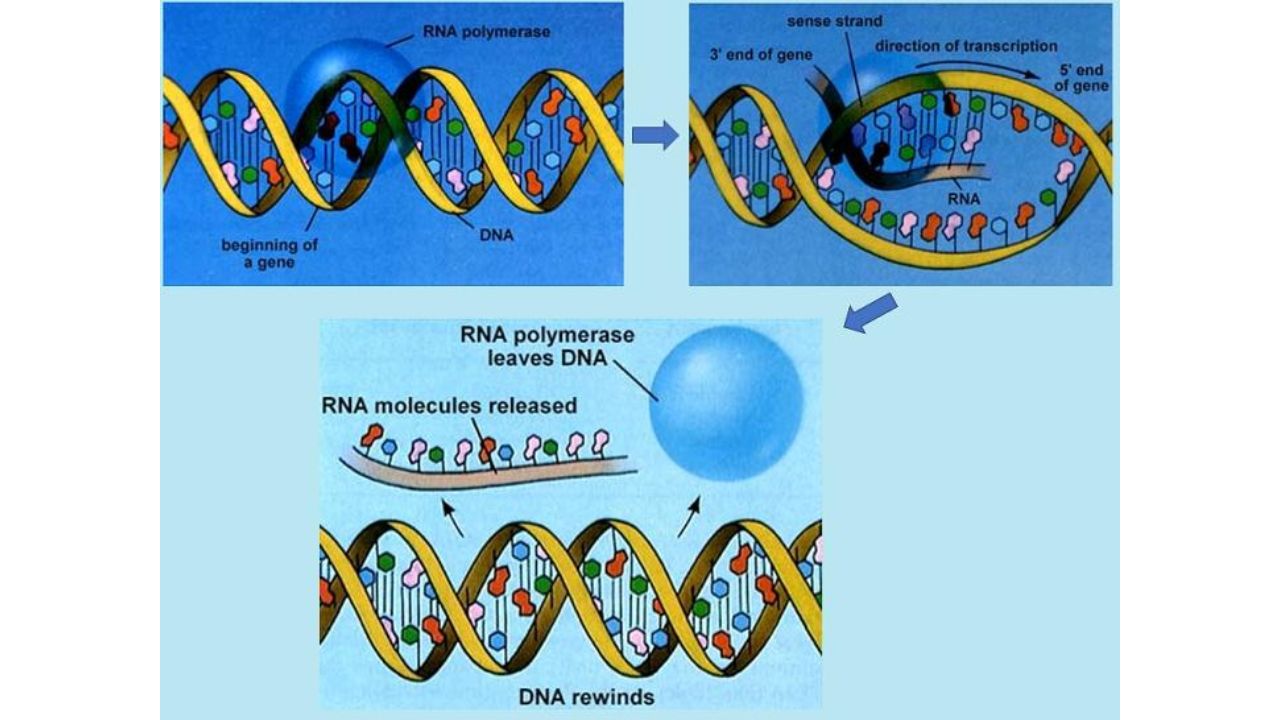 Basic Transcription Process
After initiation, RNA polymerase (RNAP) undergoes a conformational change, moves along the template, and continues to synthesize RNA, i.e., enters the elongation phase. When the polymerase reaches the transcription endpoint, it stops the synthesis reaction with the help of a termination factor, the enzyme and RNA strand detach, and transcription ends.
The first step in a metabolic pathway is often the rate-limiting step. Similarly, transcription is the first step in gene expression, and therefore a key step in gene expression regulation. Of the three stages of transcription, the regulation of the initiation stage is the most important.
For the regulation of transcription initiation, the promoter is the most important regulatory element. A promoter is a DNA sequence that RNA polymerase recognizes and binds to to begin transcription. Promoters are crucial for gene expression, determining in which tissue, growth stage, or conditions the gene is expressed, as well as the frequency of expression.
Strong promoters initiate transcription on average every 2 seconds, while weak promoters require more than 10 minutes. Studies have shown that the productive transcription rate (i.e., the synthesis of full-length RNA product from a given promoter) can vary by more than 10,000-fold for different promoter sequences.
Promoters can be viewed as a series of markers on DNA, indicating the start of transcription, the site where the double helix unwinds, RNAP binding sites, and various transcription-related protein binding sites, etc. Based on this information, transcription can begin successfully.
In prokaryotes, promoters are typically located upstream (5′ end) of the gene and consist of several conserved sequences. About 5-10 bases upstream of the transcription origin (TSS) is the conserved sequence TATAAT, called the Pribnow box or -10 box. Its abundant AT content facilitates local unwinding.
Around -35 is a conserved TTGACA sequence, called the -35 sequence or Sextama box, which provides the signal for RNA polymerase recognition. These two sequences, along with the transcription origin, are essential for transcription and are called the core promoter.
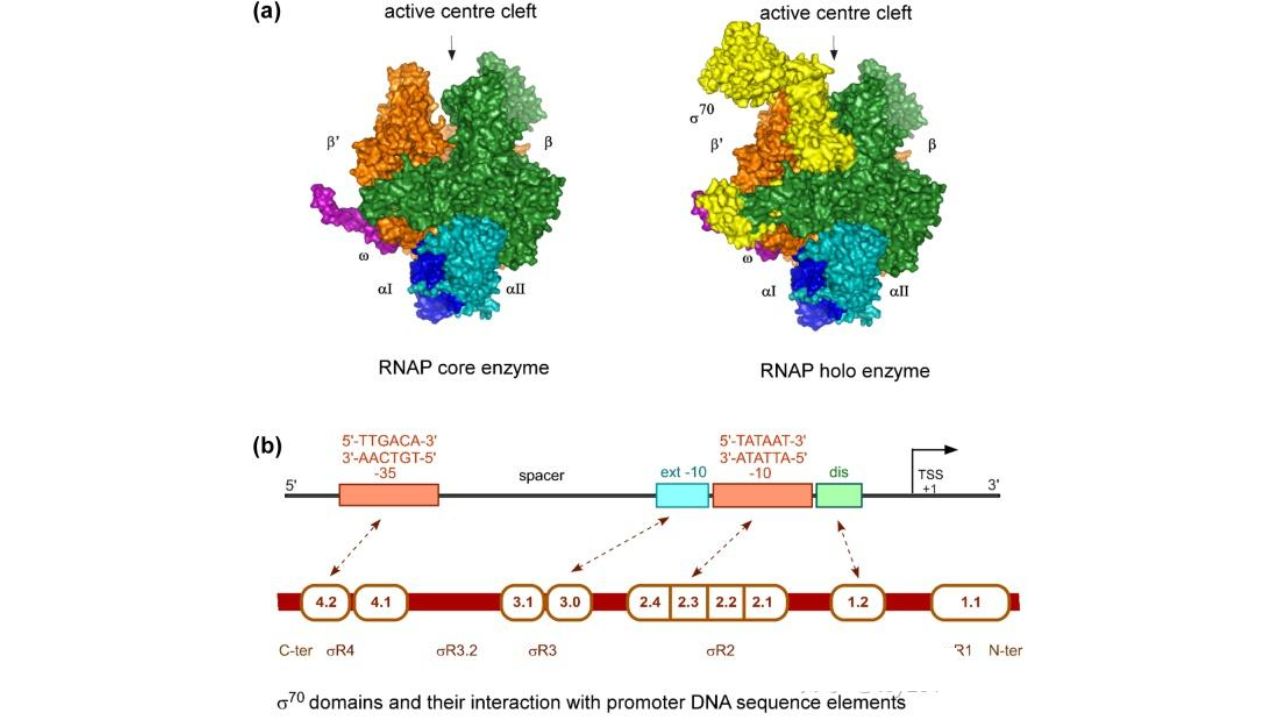 Bacterial RNAP and the core promoter. J Mol Biol. 2019.
Prokaryotes primarily recognize promoters through σ factors (σ subunits of RNAP). There are many types of σ factors, each suited to different situations. Among them, σ70 has been extensively studied and is responsible for the transcription of bacterial housekeeping genes. σ70 has four domains, all of which interact with the core enzyme and the promoter. Domains 2 and 4 bind to the -10 and -35 regions, respectively.
The -40 to -60 region further upstream is called the upstream control element (UCE) or up element, which interacts with the carboxyl-terminal domain (αCTD) of the core enzyme α subunit, inducing upstream DNA to bend and wrap around the RNAP. This is also related to transcription initiation.
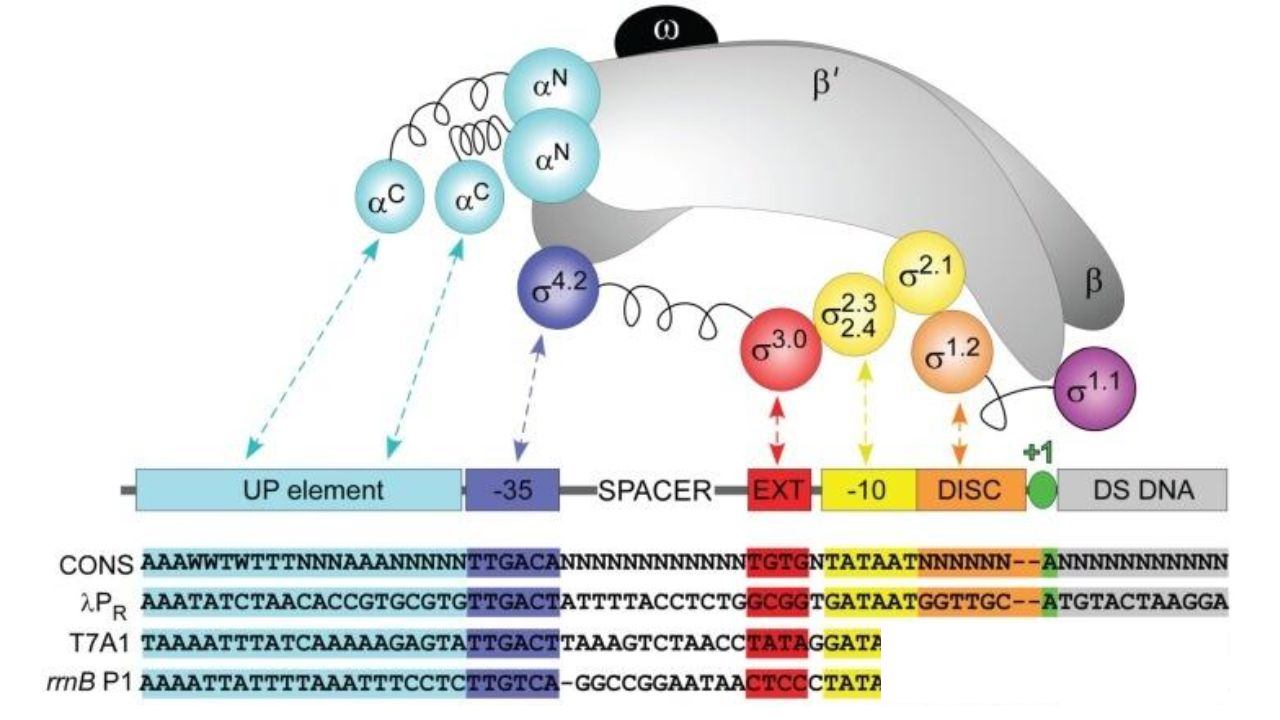 Bacterial promoter-RNAP interaction. Biomolecules. 2015.
Transcription initiation can be broken down into three steps: the RNAP holoenzyme binds to the promoter DNA to form a closed complex or “pre-initiation” complex; the DNA around the transcription start site unwinds to form an open complex; and finally, the transition from initiation to elongation occurs through “promoter escape.”
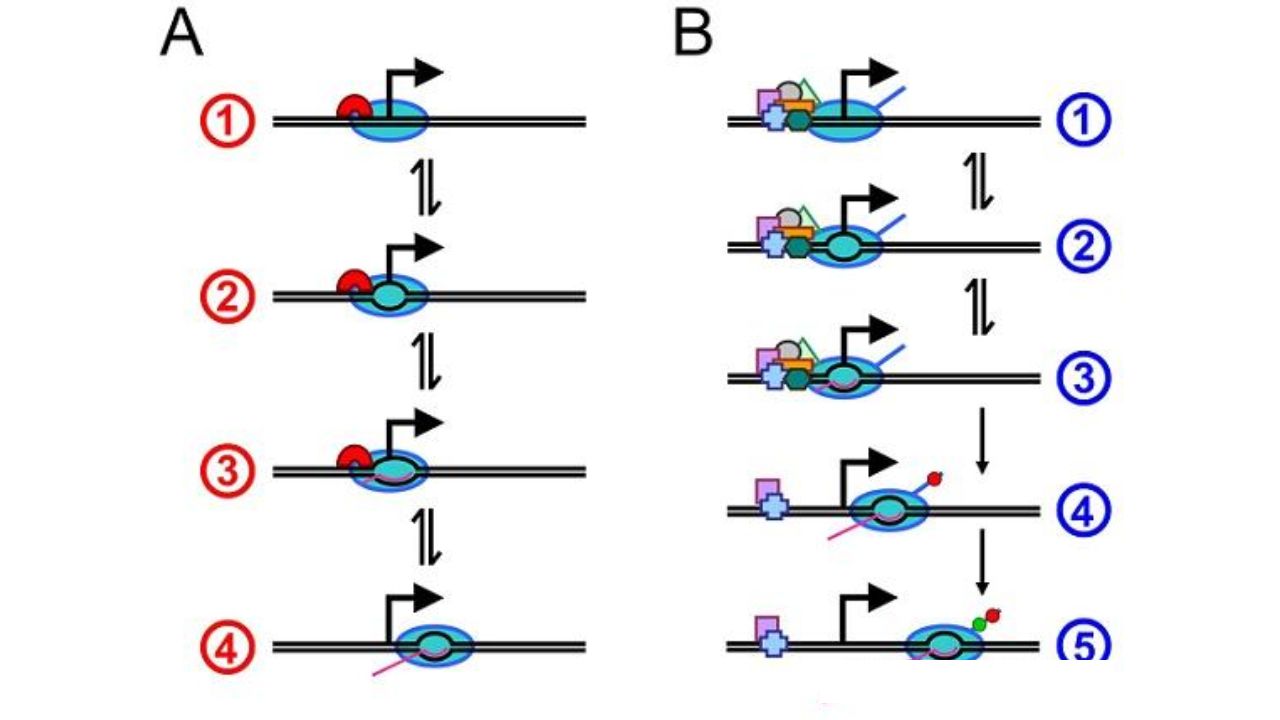 Transcription initiation in prokaryotes and eukaryotes. Curr Opin Genet Dev. 2008.
During initiation, the RNAP holoenzyme first searches for and specifically recognises promoter DNA, forming an initial closed complex commonly termed RPC (where R denotes RNAP, P denotes promoter, and C denotes closed). Subsequently, the α-CTD interacts with upstream elements, causing the upstream DNA to bend around RNAP. This action allows the downstream double-stranded DNA to bend into the active site cleft of RNAP, forming a higher-order closed complex.
The closed complex opens the promoter DNA through a series of conformational changes, forming the open complex RPO. The specific process is not yet fully understood, but a heparin-sensitive early intermediate I1 has been identified, in which the promoter DNA is in double-stranded form. It slowly transforms into a heparin-resistant late intermediate I2, which contains single-stranded DNA vesicles (−11 to +2). I2 eventually transforms into the stable open complex. Different models exist for this process.
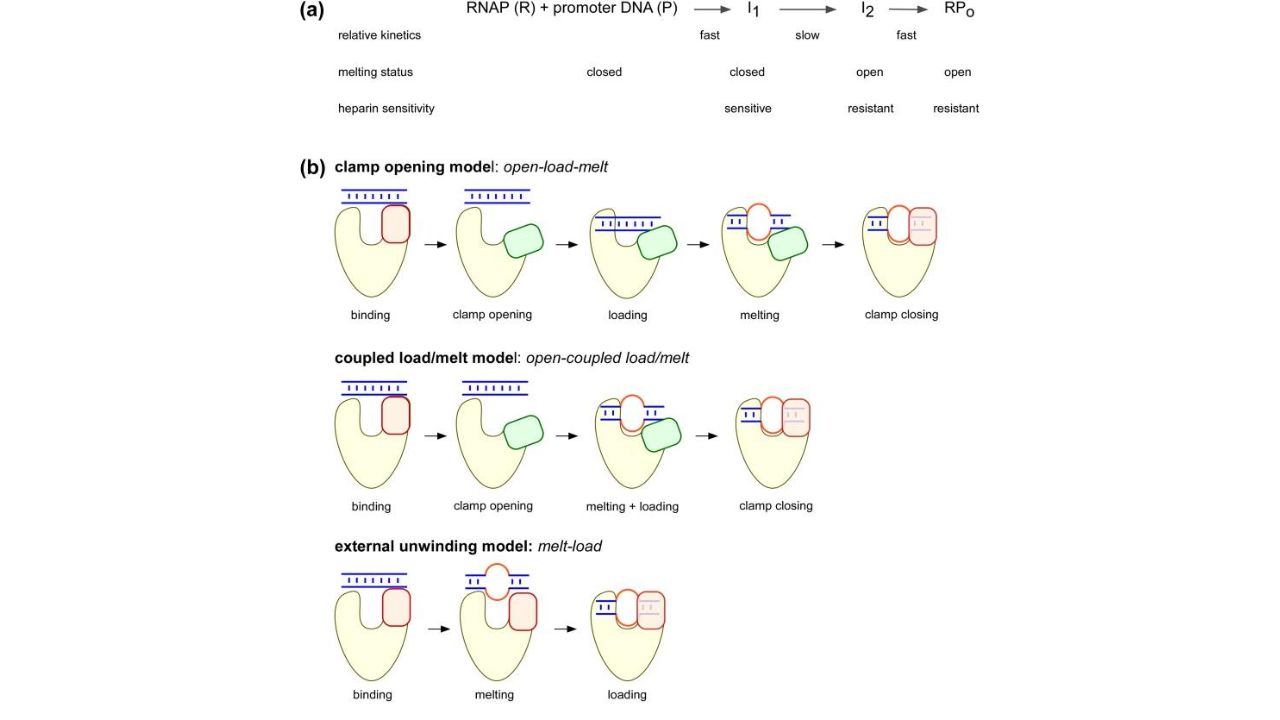 The transition from the closed complex to the open complex. J Mol Biol. 2019.
After the formation of the stable open complex, the polymerase begins RNA synthesis, but not every synthesis successfully enters the elongation phase. When RNAP synthesizes RNA of 9 to 11 nt in length, if RNAP can dissociate from the promoter, it can enter the elongation phase. If RNAP cannot dissociate from the promoter, it releases the short RNA, reverts to RPO, and restarts RNA synthesis; this is called the abortion pathway. The balance between production and failure pathways depends on the promoter and the initial transcription sequence.